
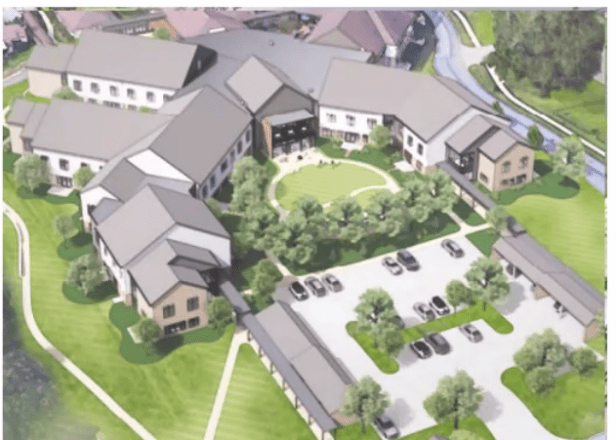
In a series of three presentations over the past few weeks, we’ve learned a lot about the possible sustainability aspects of the expansion of the Kendal Center healthcare wing.
In this post, I’ll touch on the major energy-related topics that have been covered in the presentations. The first two presentations (April 27 and June 1) were specifically for the Kendal Energy committee, and were conducted entirely over Zoom. The third (June 6) was for all interested residents, and was hybrid (auditorium and Zoom). All three were hosted by Seth Beaver and involved representatives from Steven Winter associates (our sustainability consultants) and Lenhardt Rodgers, the architects involved.
The first presentation, which occurred April 27, outlined the basic aspects of sustainability for a project of this kind, and some of the potentially relevant standards. However, it did not nail down specific targets that the project should meet.
The second presentation was much more specific. This time, Sean Fish, the presenter from Steven Winters, made a series of specific recommendations. (Because they are recommendations, it is possible they may not get implemented. However, the fact that KCC is making them public suggests that the recommendations could well be adopted.)
The third presentation, for all residents, covered much of the same sustainability ground, as well as the current state of the overall architectural design. That presentation was recorded, and you can view it here. The first two presentations were not recorded.
Energy-saving recommendations. Three of the recommendations by the Steven Winters team dealt specifically with the energy that will be used by the healthcare wing, once it is in operation.
First, they recommend that the new construction be designed to meet the federal Energy Star v3.1 standard and reduce energy use to make it at least 10% below what current PA building code requires.
The second recommendation is that sub-metering of electricity and gas be implemented so that energy consumption by the healthcare wing is measured separately from the rest of the campus. The entire campus is currently on a single meter for both electricity and gas.
Once there is separate metering for the healthcare wing, its total energy use (and, from that, its carbon footprint) can be calculated. This calculation can be repeated each year, allowing us to track the facility’s efficiency going forward. Additionally, that data, plus the square footage involved, can be entered into a software package called Portfolio Manager, developed by the Department of Energy. That software will enable us to compare the efficiency of our healthcare facility with that of many others across the country. (Portfolio Manager is also the software package that Senior Stewards Acting For the Environment—SSAFE.org—has adopted as its standard for comparing retirement communities.)
The third recommendation is that solar panels be installed, but the number of panels was left unspecified. In the second presentation, the idea was floated that the number should be equivalent to those installed at Crosslands on the new Woolman Building. There was discussion in the meeting about whether this equivalence mattered. The sense of those speaking was that the number of panels at Crosslands was not important—we should go for as many as possible at Kendal. Joyce Lenhardt pointed out that setting a target amount of solar was valuable because it would permit goal-setting and tracking progress. However, no specific goal arose from the discussion.
An important point that was briefly mentioned in the sustainability recommendations is that the Energy Star standards we will be implementing require third-party verification. In other words, it is not enough to specify the standards that the contractor is supposed to meet, and it is not enough for KCC to try to hold them to those standards. An independent third party must confirm that the standards have been met. That turned out to be a very valuable feature of the recent construction at Crosslands, and it will be equally important here.
Currently, the entire Center is heated using circulating hot water from a boiler fired by natural gas. Somewhat disappointingly, that won’t change with the new construction: the same boiler will heat the expansion as well. Fortunately, no additional boiler capacity will be needed. Once the boiler reaches the end of its working life, it can be replaced by an electric boiler, eliminating a significant use of fossil fuels. (Of course, fossil fuel use is not eliminated entirely if the electricity used is generated, in part, from fossil fuels. But it’s the place to start.)
Water conservation, sustainable materials, and indoor air quality. The sustainability consultants are recommending a series of initiatives that have to do with water conservation, construction material features (and control of waste), and means for ensuring good indoor air quality. I won’t go into these in detail, but if you are interested I recommend you watch the video.
The recommendations include the following items, among others:
- Reducing use of water to 25% below baseline LEED requirements, mostly by the choice of efficient fixtures
- Use of sustainably produced materials which won’t “offgas” chemicals into the building
- Where possible, replacing commercial natural gas appliances with electric equivalents
- Dealing with light pollution
- Capturing rainwater to prevent excessive runoff
- Avoiding runoff from the construction activity itself
Conclusions. Personally, I am pleased by the amount of effort going into planning for sustainability. Assuming the recommendations are implemented, this will be a construction project we can be really proud of. I endorse all of the recommendations that the sustainability consultants are making.
There are three ways that I think we can easily do even more than what has been proposed so far.
First, there is the matter of accounting for the use of energy in the Center. Personally, I hope the entire Center—not just the healthcare wing—is also sub-metered for electricity and gas, since we don’t currently know what fraction of our energy is used by the Center vs. what is used by independent-living housing. That’s a critical piece of information. If the Center is using, say, 75% of our electricity, we need to look at what measures we can take to improve it. If, on the other hand, our cottages are using 75%, fixing them up becomes the priority. Without sub-metering, we don’t know where to focus our attention.
Second, why not use this opportunity for a full, in-depth energy audit of the Center? Kendal at Hanover recently had that done, and it cost them just $32,500 (far less than 1% of the cost estimate for the healthcare expansion). That would tell us where the biggest opportunities for energy savings are, beyond those associated with the expansion project. We can use a similar “request for proposal” to bid out the project (like Hanover’s, our RFP can be based on the template developed by SSAFE.org).
Finally, let’s plan to make it our goal to put solar on all Center roofs, existing and planned, that are suitably oriented and not shaded. Is there a reason not to set this goal? Current federal incentives make this financially attractive. Seth mentioned, in his remarks during Q&A, that KCC may apply for Inflation Reduction Act funds for the newly-installed solar panels at Crosslands. We can do that at Kendal too.
 On the Kendal Journey
I agree with you, George, especially with the idea of installing as much as possible.
LikeLike
thank you for the helpful summary
LikeLike
This reflects a lot of har hard work and strong leadership – – Thanks!
LikeLike
George’s report shows that the Health Center project gives KCC an opportunity to step forward, in energy saving, in the way Kendal at Longwood often did in years past, leading rather than later playing catch-up. In that so many of the community structures are 50 years old and that the wear and tear is visible to visitors, the Health Center could demonstrate Kendal’s excellence and attention to the worlds needs. Let’s be bold and support what George has proposed. What do others think?
LikeLike