
On Tuesday through Friday of this week, residents will see “Peak Day Alert” signs, posters, emails, and web notifications for Kendal and Crosslands. You’ll be encouraged to reduce your electricity usage between 4:00 and 6:00 each afternoon. This is the fourth year for these alerts, and many residents have a general sense of what they’re about, but very few know the whole story.
It started back in early 2020, when Seth Beaver (who was Facilities Director then) shared an electricity bill with me (as Energy Committee chair). It contained a large item (over $8,000/month) called “Capacity Charge”, which I didn’t understand. Learning about it led me down a grid-management rabbit hole. Bear with me a minute here: I’ll return to the peak alerts shortly.
PJM manages our region of the grid. The US electricity grid is managed by regional organizations. Our region of the grid is managed by an organization called the PJM Interconnection (PJM.com). It serves a vast region, from Chicago to New Jersey and south to Virginia. One of its jobs is to make sure electricity customers have the electricity they need, when they need it.
Every day, PJM manages the electricity on the grid by letting the lowest-cost providers supply the amount needed to satisfy the electrical demand.
Coping with extreme demand peaks. But what about extreme demands, like the hot spell we are heading into this week, when everyone’s A/C will be running at the same time in the late afternoon? Will there be enough generation?
To handle extreme demand, PJM runs a “capacity market” in which generation providers can offer generators that will be kept on standby and only be run when called upon by PJM. These are generally the oldest, least efficient, and most polluting generators, and they are only run a few days a year, if then. In many cases they are not run at all. But even so, PJM requires them to be ready to run, and pays them for that.
So PJM is in the position of paying companies to have generation ready although it is never used. How does that get paid for? Normal electrical billing is based on a price for the amount of electricity you use, not the amount you might have used if there had been extreme demand.
PJM solves this problem by assessing a “capacity charge” based on the amount of electricity the customer has used during previous peaks. At the end of each summer, PJM reviews the usage of all the commercial customers in its territory (residential customers are not billed). It takes the amount of money it has paid generators to be on standby and divides it among the customers according to how much electricity they used during the five highest-demand hours of the year. That amount is the “capacity charge” on the bill.
Predicting the five highest-demand hours. Clearly, a commercial customer (which KCC is) can’t know ahead of time what the five highest-demand hours of the summer will be. History is of some help: with very few exceptions, the highest-demand hours are always either 4-5 p.m. or 5-6 p.m. The peak demand in past years provides a general idea of what a peak might be in future years.
Our Energy Committee uses that information, plus the 7-day demand forecast that PJM posts every day, to determine when to call a “peak alert”. Jim Craig, Gary Johnson, and I do that work. We are assisted by Joel Brody, a resident at Collington (a Kendal CCRC in Maryland) where there is a parallel program.
We try to make sure to issue an alert for any day that might be a grid peak day. That means there will be alerts for days that, by the end of the summer, turn out not to be in the top five. In the past three years, we have had peak alerts on between 6 and 13 days.
What about this summer? We had a cool start to the summer, but now we are heading into a hot stretch. The entire PJM region is affected by a “heat dome”, which means regional grid peaks are likely. Will there be even hotter weather later? We don’t know, so we have to assume the current weather is as hot as it will get.
The graph below shows the PJM demand forecast for the next seven days.
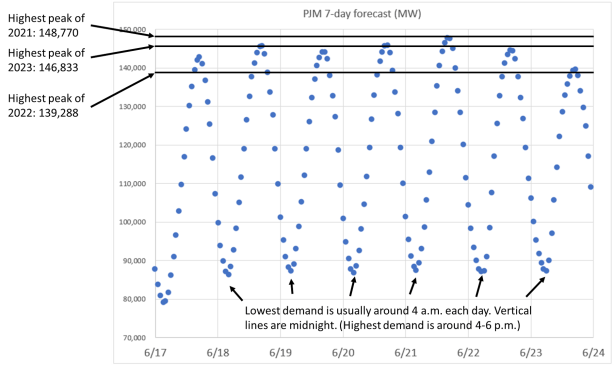
Each of the dots represents the predicted demand for electricity for one hour. You can see the daily cycle: low demand at night until around 4 a.m. and high demand during the day, peaking in the late afternoon.
The horizontal black lines near the top of the chart show the peak demand for the last three years. Clearly, we are on track to tie, if not exceed, the peaks of previous years, and we’re still just in June!
Note how the demand drops off on 6/23 (Saturday) and 6/24 (Sunday). That represents the drop in commercial and industrial demand on the weekend. It will pick back up next week, and who knows—it could exceed this week’s demand on some days. If that becomes likely, we’ll issue another peak alert.
It isn’t about us, and it isn’t really about saving electricity. Note that the surcharge on our bill is based on electricity we use when the grid hits a peak, not when KCC has its own peak usage. If it’s cool in Chicago or Pittsburgh or DC, the PJM region won’t hit a peak even if we’re setting heat records here. And if it’s not a grid peak, we won’t get hit with the capacity charge.
Note also that the only hours that figure into the capacity charge are the five hours when the PJM region has a peak. Whatever electricity we use outside those hours, the capacity charge will not be affected. So this program is primarily focused on shifting electricity use out of peak hours, not on cutting back on electricity use (although that’s certainly worth doing too).
 On the Kendal Journey
Excellent explanation!
LikeLike