
This is a guest post, written by Crosslands resident Allen Prindle.
The 2016 Paris Agreement states we need to reduce greenhouse gas emissions 50% by 2030 and 100% by 2050. The Energy Committees at Kendal at Longwood (KAL) and Crosslands have been publicizing these goals by working toward energy efficiency and clean energy. Pennsylvania has a Climate Action Plan with a goal of 80% reduction in emission levels by 2050, from 2005 levels. Chester County’s Climate Action Plan has the same goal as the state. Senior Stewards Acting for the Environment (SSAFE) has a climate goal of reduced emissions by 50% by 2030 and net carbon neutrality by 2050.
As the Chair of the Crosslands Energy Committee, I have been working closely with George Alexander, Chair of the KAL Energy Committee. These committees work with residents, staff and administration to support decisions to lower greenhouse gas emissions, and address climate goals. This paper describes a report on KCC’s progress toward reducing CO2 emissions.
It is important to measure the progress toward the Paris goals. A Carbon Footprint Study was conducted by reviewing billing and delivery data from 2023 for Kendal-Crosslands Community (KCC). The results are shown in Table 1, which show the metric tons of CO2 emissions from diesel, gasoline, propane, natural gas and electricity used at the KAL and Crosslands during 2023. A total of 5590 metric tons of CO2 emissions were shown, with 75% from electricity use, and 20% from natural gas.

The first solar panels at KCC were made operational in September 2023. A total of 9190 kWh of electricity was generated from the 108 solar panels at Crosslands campus in 2023.
A comparable carbon footprint study was done in 2019, so a comparison can be made to learn if progress is being made toward the Paris goals. The 2019 Footprint study results are shown in Table 2, and show 8549 metric tons of CO2 emissions.
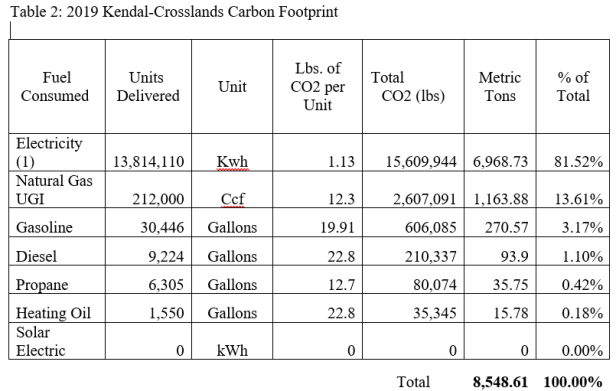
A comparison between the 2019 study and the 2023 study shows there has been a 35% reduction in CO2 emissions. This comparison uses 2019 as the base year. Future years can be compared to this base year.
A detailed comparison for each energy source is shown in Table 3. For example, it shows there was a 5% reduction in use of electricity during the period. Natural gas declined by 4%, while gasoline, diesel and propane declined more than 20%. Solar energy production at Crosslands was installed in 2023 and produced over nine thousand kWh from September 14, 2023 to December 31, 2023. This and future installations of solar will allow KCC to reduce purchases from the PA grid and lower CO2 emissions.
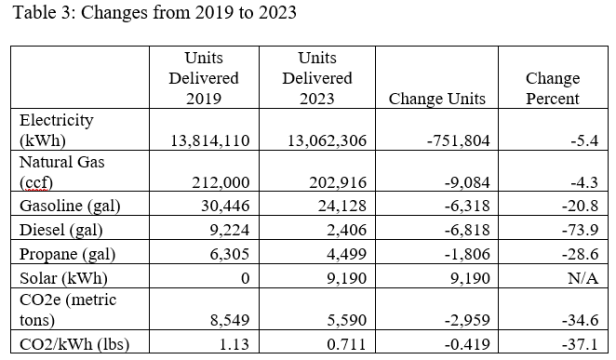
It is of interest to note that while the kWh of electricity decreased by 5%, the CO2 emissions per kWh decreased by 37%. Because electricity is more than 75% of the CO2 emissions, most of the CO2 reduction is explained by the cleaner PA grid.
Following is a brief list of how each source of energy is used at KCC.
- Diesel: vehicles, generators
- Gasoline: vehicles, lawn care equipment
- Propane: Maintenance center heat, outdoor events
- Natural Gas: heat for community centers, hot water for pools, kitchens, laundry
- Electricity: Water treatment pumps, IT, lighting, independent living hot water, heat, kitchens, more
As KCC plans to reach the 50% reduction of greenhouse gases by 2030, there should be a plan to lower emissions from the list above. There need to be plans to use less gasoline or diesel. And plans to shift to cleaner fuels, and plans to use less electricity or natural gas. Lower CO2 emissions would result from additions of more solar energy production to replace purchased electricity from the PA grid.
If the PA grid had not gotten cleaner, and the CO2/kWh had stayed the same as 2019, KCC would not be on a path toward 50% reduction by 2030. The CO2 emissions with that single change would result in emissions of 8072 metric tons. This is compared to the current level of 5590 metric tons.
With 2019 as the base year, there is a 11-year period from 2019 to 2030. The year 2023 is year #4. If the CO2 emissions reduction were linear to 2030, KCC would need to reduce emissions by 390 metric tons per year. For 2023 the trend emissions would be 6988 versus actual emissions of 5590. This is a difference of 1398 metric tons that has already been achieved by 2023. The goal for the year 2030 would be 4274 metric tons, or 50% of the CO2 emissions in 2019.
KCC is on a path toward 50% reduction of CO2 emissions by 2030. This conclusion is based primarily on the cleaner grid, not by actions taken at KCC. Future efforts to reach CO2 reduction goals will require additions of clean electricity and reductions in natural gas and other carbon fuels used at KCC. The 2024 energy audit for the Crosslands Community Center and the 2025 energy audit at KAL community center is expected to highlight steps to reduce electricity and natural gas use, and reduce emissions in future years.
Allen Prindle, Crosslands Resident, May 2024
 On the Kendal Journey
Are the GHG emissions for natural gas including estimates of the effects of methane leaks in nat gas extraction and distribution?
=== Bernie Banet === Ann Arbor, Michigan
LikeLike
Good point, Bernie. I believe the figures used here are just the carbon involved in actually burning the gas.
LikeLike