
While visiting relatives in Ann Arbor, Michigan, I had my first experience of riding in an autonomous vehicle. Each summer, Ann Arbor hosts a vast outdoor art fair (actually a combination of three fairs, sponsored by three separate arts organizations). Streets are closed off in large areas of downtown Ann Arbor, including the streets surrounding the main campus of the University of Michigan.
To help fair-goers get around the town, there was a free shuttle service consisting of about half a dozen autonomous vehicles running a loop of 7 stops around the periphery of the art fair areas. The service was run by May Mobility, an Ann Arbor company developing hardware and software for autonomous vehicles. I took a ride to see what the experience would be like.
The vehicles used for the Ann Arbor service were modified hybrid-electric Toyota Sienna minivans. They were equipped with multiple sensors (video, radar, and lidar) and controlled by May Mobility’s car-based software.
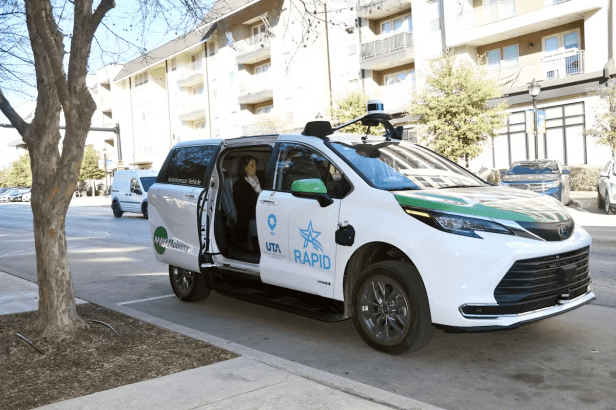
When I arrived at one of the 7 vehicle stops, a family of five was there ahead of me. Within a minute or two, an autonomous vehicle arrived and the family piled in, leaving no space for me.
I waited a few more minutes until another vehicle arrived. Although the vehicle didn’t have a “driver”, there was a person sitting in the driver’s seat. He was an “autonomous vehicle operator” (AVO), ready to take control if necessary. I was the only passenger until I got out five stops later. That gave me time to get impressions of the vehicle and the ride, and to ask lots of questions of the AVO (who was a college-age test driver employed by May Mobility).
The driving experience. I noticed two situations when the AVO took over from the car’s autonomous capability. One was in pulling away from the curb (I didn’t ask why he chose to take control then) and the other was at a location where construction was happening and one of the two lanes had been fenced off. The AVO explained that the fence was new and the car had not been sufficiently trained on it yet, so he piloted the car into the remaining lane manually. Otherwise, he let the car drive itself.
I noticed one driving-behavior quirk: the car made a small, unexpected maneuver when it started up from a stoplight. It made two small, quick turns, right and left, before continuing straight ahead. The turns weren’t big enough to have an effect on the car’s path, but they were quite noticeable. I asked the AVO about them. He was familiar with the behavior, but didn’t know its purpose.
Overall, the driving experience was smooth and comfortable. I never felt uneasy during my trip.
The May Mobility approach. May Mobility is an interesting company. It is far smaller than the major players in autonomous vehicles. Those companies tend to be offering alternatives to public transportation (such as “robo-taxis”) and see city managers and regulations as impediments to be overcome. May Mobility prefers to position its offerings as supplemental to existing public transportation, and the company seeks to work with cities. It tends to view cities as customers, not competitors.
The company sees autonomous vehicles as particularly valuable to seniors and the disabled, both groups that aren’t always able to take advantage of public transportation. One result of this philosophy is a major test site at Sun City, AZ, a 55+ community near Phoenix. That site, launched in April 2023, is now transitioning to a “rider-only” option (no AVO), for which it is recruiting volunteer riders.
A more recent test site is Detroit, where seniors and those with disabilities can get free rides on self-driving shuttles. That project was launched on June 12, 2024. Riders must be 62+ years old, or have disabilities. Rides can be scheduled by a smartphone app or (for those without a smartphone) by calling a specific phone number.
The services in Sun City and Detroit are both free, which is also the case at most May Mobility test sites. There is only one site (the University of Texas at Arlington) where riders pay a $3 fee, and even at that site rides are free for students and staff.
May Mobility’s model emphasizes specific routes and specific stops, just as I experienced at the art fair. According to their PR spokesperson, Morgan Skarda, “May Mobility’s mission is to connect everyone with accessible transportation, including those with disabilities to essential services and community resources (i.e. schools, medical facilities, health clubs, community centers, etc.). Pick-up and drop-off locations are predetermined and unique to each deployment site based on rider demand and feedback. May Mobility is consistently collecting and analyzing feedback to improve routes and drop-off points.”
The company’s mission to serve seniors aligns well with its focus on driverless vehicles, but the match is less than perfect when it comes to the disabled—wheelchair users in particular. For them, the company will continue to offer an AVO (not a “driver” but still an employee who is paid to be along for the ride) to help with loading and securing the wheelchair.
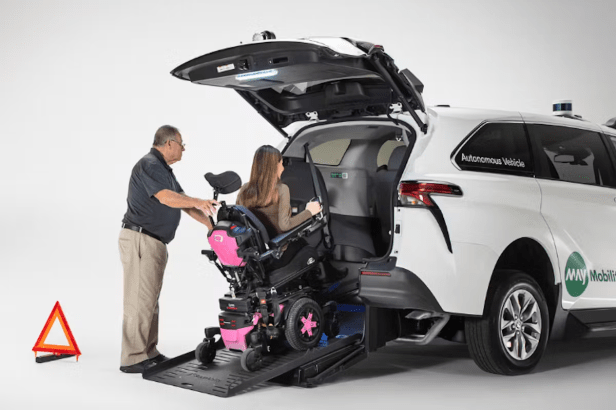
May Mobility has a variety of partners and funders, including Y Combinator, a prominent Silicon Valley venture capital firm.
Navigation strategy. May Mobility distinguishes its software approach from that used by other self-driving vehicles. While other companies use machine learning to derive rules based on thousands of miles of human (or human-supervised) driving, May Mobility focuses more on real-time evaluation by a computer in the car than on rules.
Here is how the company describes its approach: “May Mobility’s Multi-Policy Decision Making system is uniquely designed to solve the challenge of making safe driving decisions under uncertainty, including when the vehicle encounters an unknown scenario. MPDM runs real-time, on-board simulations to analyze thousands of possible scenarios every second, choosing the safest one to execute. This approach to autonomous technology makes May Mobility vehicles adept at handling edge cases and enables the company to scale more efficiently and quickly than would otherwise be possible.”
As a passenger in Ann Arbor, I could watch a real-time display generated by the car’s computer, showing our position relative to other cars, pedestrians, bicycles, street markings, and so on, all changing in real time.
Potential at Kendal-Crosslands? I can envision practical applications for this technology at Kendal-Crosslands. Despite the proximity of the two campuses, there is surprisingly little resident travel between them. Shared staff are heavy users of the connecting service road, but residents tend to stick to their own campus, thus missing many unique events and facilities available to them on the sister campus. An autonomous shuttle service between the campus would go a long way toward improving that.
Within each campus, a vehicle that could take people to and from the Center would get a lot of use, in my opinion. This would be particularly valuable at Crosslands, where the distances are greater and there are few covered walkways. There is bus service at meal times, but (from what I hear) it is far from ideal. An autonomous vehicle (either on call or running a frequent, scheduled route) would be a big improvement.
Finally, at some point in the future, I can imagine an opportunity for a service that would take residents off campus to nearby destinations such as the Giant supermarket or local medical appointments.
 On the Kendal Journey
Fascinating. It sounds as if it would be a useful device to experiment with as KCC undertakes strategic planning to stay at the leading edge of senior services.
LikeLike