
What if you had a friend with access to all the latest data on the state of the world and its climate. Your friend knew the extent of the pollution problems and had read the scientific papers on all the systems that sustain life on earth.
Suppose you asked your friend, with all that knowledge, two questions: (1) Is the state of the world improving or declining? (2) What problems would you select as the most pressing and in urgent need of attention, and which ones would you decide are not critical right now?
None of us has such an all-knowing friend. But if we did, that person would be a little like Hannah Ritchie, the author of the new book “Not the End of the World: How we can be the first generation to build a sustainable planet” (Little, Brown 2024).
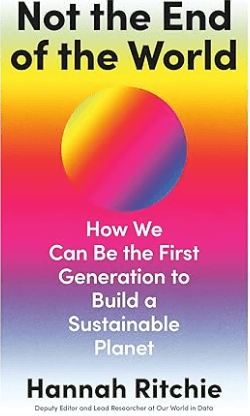
Ritchie, as Deputy Editor and Lead Researcher at the well-regarded website “Our World in Data”, is ideally positioned to provide a science-based answer to the two questions posed above. In fact, answering those questions is her book’s focus.
In answering these two questions, Ritchie’s position is one of “urgent optimism”. As regards the first question, about the overall state of the world, Ritchie is somewhat optimistic. Certainly, we face serious problems and we must solve them, but (despite the headlines you may have read) the world is making steady progress on many critical fronts: child and maternal mortality, life expectancy, hunger reduction, clean water, education, and poverty. These have all been steadily improving for decades, and Ritchie has the data to prove it. That’s the “optimism” part of our situation.
On the other hand, there is the “urgent” part—problems in need of immediate attention. These occupy the bulk of the book. Ritchie has selected seven to focus on: air pollution, climate change, deforestation, food, biodiversity loss, ocean plastics, and overfishing. Ritchie takes a close look at the available data about each of these.
One very useful aspect of Ritchie’s approach is that she uses her data resources to distinguish between actions that can make a big difference and actions that have minimal impact. For most of the seven problem areas, she lists commonly-mentioned “solutions” that we could “stress less” about because they wouldn’t really move the needle (although they might have symbolic value). Some of these recommendations surprised me, as I’m sure they will most of you.
What’s most important in dealing with climate change? To make this point more specific, consider the chapter on climate change. Yes, greenhouse gas emissions are still rising (although not quite as fast as population growth, a positive sign). Many countries are reducing their emissions, and low-carbon technology is getting steadily cheaper.
Clearly, we need to fix our energy industries, our transportation, and our food supply (and Ritchie provides lots of good information on how these need to change). Construction (and cement in particular) is a problem that needs fixing. We really need a price on CO2 (and other greenhouse gases), so that those emitting it are charged appropriately.
To deal with the climate change that is already occurring, we must reduce poverty, develop more resilient crops, and adopt improved ways of handling hot weather.
You probably agree with most (or all) of the actions listed in the preceding two paragraphs. On the other hand, Ritchie is forthright about telling us that we should “stress less” about some of our favorite climate-saving activities, including recycling, replacing our light bulbs, reducing the electricity used by our TVs and web browsing, changing our methods of dish washing, choosing between paper books and electronic reading, seeking out local food and organic food, reducing electricity used by devices on standby, and choosing between plastic and paper bags. Ritchie presents data supporting each of these positions, and she might even convince you to change your mind about a few of these.
That summary gives you a flavor of Ritchie’s coverage of climate change. She provides similar specific and data-based advice in each of the other areas she covers: air pollution, deforestation, food, biodiversity loss, ocean plastics, and overfishing. In each case, some of her recommendations will probably undermine a few of your cherished beliefs.
In the end, she chooses two particular areas that she sees as most critical right now: air pollution and biodiversity. (She fears the latter is not likely to get the attention it needs.)
The broad scope of Ritchie’s book and the trove of data it is based on make it an extremely valuable resource. From my point of view, “Not the End of the World” is the most important book I have encountered this year, and one of the most valuable of the last decade.
Three caveats. I have three cautions to readers, none of which diminishes my opinion of the book. First, Ritchie is only willing to express opinions on areas where the science is clear. For example, she acknowledges the omnipresence of microplastics, but does not offer an opinion on the extent to which they are a health hazard. Fair enough: there simply aren’t answers on that yet. Second, her focus is global, and so are her priorities. She doesn’t tell you how to set the priorities for, say, the US or your specific community. You’ll need to look elsewhere for that.
And third, most of the actions that can make an important difference, according to Ritchie, are not things individuals can do on their own. They must be done by larger groups—mostly businesses, countries, or international organizations. And yet, I feel it is important to encourage people to do whatever is in their power to do. Those actions help create a movement around sustainability, which in turn creates the impetus for businesses, countries, and international organizations to act.
Our Kendal library has purchased a copy of “Not the End of the World”. It’s rare that I buy a book when it is available from our library, but this is such an important reference that I will make an exception. I want a copy close at hand whenever I have a question about sustainability priorities.
 On the Kendal Journey