
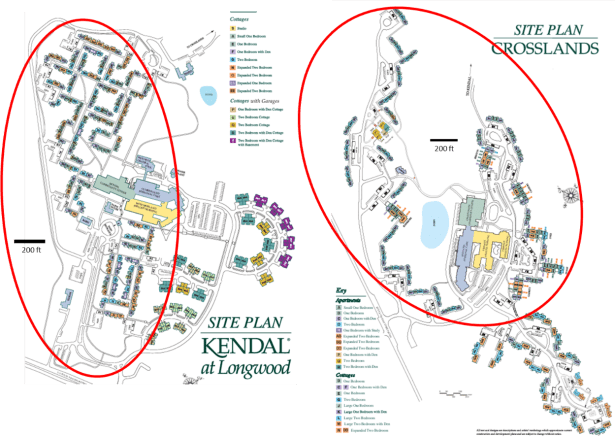
When Kendal was first laid out, in 1972, the area chosen for independent-living cottages was fairly level farmland. Between the Center and the entrance from Route 1, the ground was almost entirely flat. On the other side of the Center, there were only gentle slopes. That topography permitted a layout dominated by single-story cottages facing courtyards. The cottages were all within reasonable walking distance of the Center, and were eventually connected to it by covered walkways. Even the farthest cottage was within 1,000 feet of the Center.

When Crosslands was laid out, five years later, a Kendal-style layout was found not to be practical. The flat area suitable for building formed a horseshoe shape surrounding a valley and a pond, and the land sloped off on either side of the horseshoe. There wasn’t enough space for the kind of courtyard layout that Kendal had. As a result, Crosslands was designed with cottages spread out around the horseshoe and with seven two-story apartment buildings to permit the desired number of housing units in the available space.
Walking distance to the Crosslands Center from the farthest cottages was much greater (some are over 1,500 feet away, as the crow flies) and providing covered walkways from every unit was not practical. In fact, only one apartment building (Brinton), and a few individual cottages next to it, had covered walkways connecting them all the way to the Center. That is still true today.
Although Kendal and Crosslands are similar communities in many respects, the differences in topography and layout have caused subtle differences in the lives of residents that the founders probably did not anticipate. Those differences, especially as they affect independent-living (IL) residents are the subject of this post. In what follows, I will not discuss the impact of later campus expansions (the “400s” at Crosslands and the “Kendal East” duplexes). These expansions have changed the character of each campus somewhat, but I believe the general description below is still mostly accurate.
One consequence of the layout difference between the two campuses that is often remarked on by prospective residents: Crosslands residents usually have views of meadows or woods, giving many residents “long views” and a sense of spaciousness. Kendal cottages, by contrast, often have views of other cottages across a courtyard or a back yard, giving more of a “village” feel. This is often a significant factor in the choice of campus that new residents make.
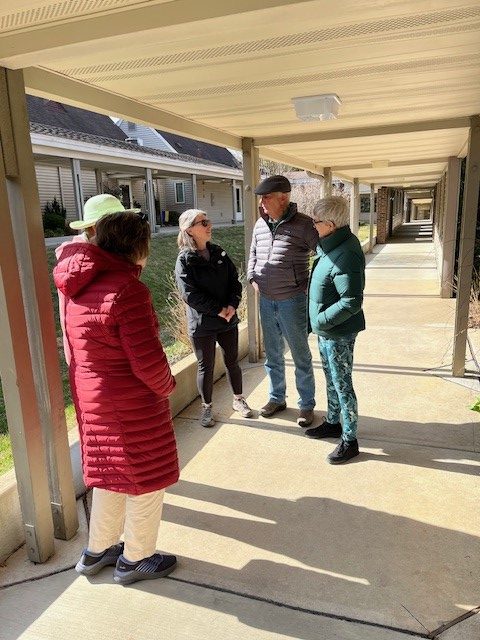
Parking, cars, bus service, and walkways. Kendal’s covered walkways made it possible for residents to walk to the Center for meals and other activities, regardless of the weather. That reduced the need for parking areas close to the cottages, and parking is at the periphery of the campus, at a distance from many of the cottages. (The exception is the newer Kendal East duplexes, which have garages, but no covered walkways.) Parked cars are not visible from most cottages. The road connecting the parking lots is also peripheral, and so residents don’t ever need to cross a road on foot if they don’t want to.
The walkways are also a significant aspect of the Kendal social scene. You constantly run into people from your side of the campus on the walkways.
At Crosslands, it was clear from the start that driving to the Center would be necessary in inclement weather. Therefore, parking was provided near every unit, along the road that is the central artery of the horseshoe-shaped campus.
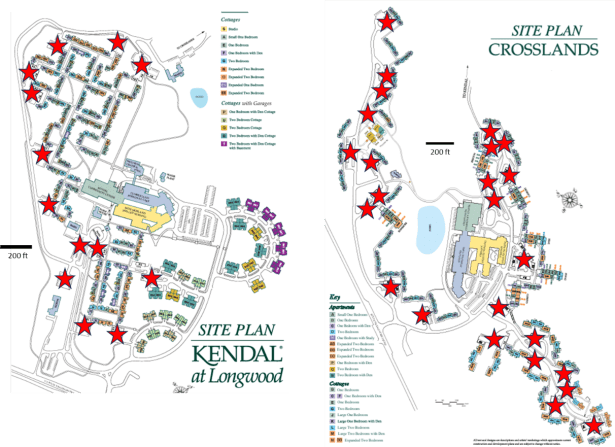
For a majority of Crosslands residents, getting to the Center on foot requires crossing the road, and the road crossings are not protected from the elements.
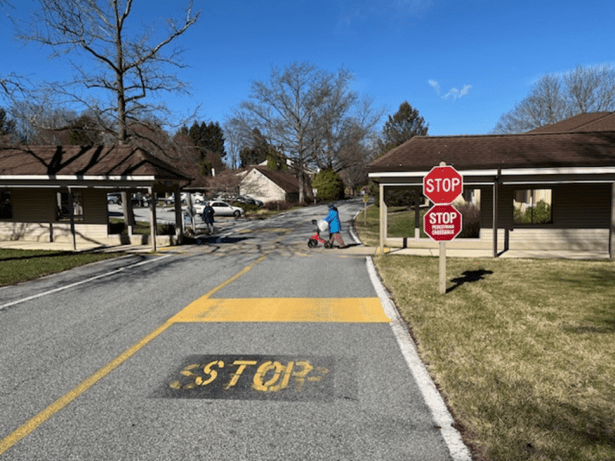
At both campuses, the Center is where most group activities take place. It is also where the dining facilities are, where takeout meals can be obtained, and where mail is delivered. As a practical matter, most IL residents will need to go to their Center at least once a day. For Crosslands residents who drive to the Center, parking becomes an issue. At certain times of the day, there is not enough parking. The nearest available parking slot may be at a considerable distance and may require crossing a road.
One solution to this problem at Crosslands is bus service. A bus routinely runs a pickup loop and a return loop at breakfast, lunch, and dinner time (on weekends, dinner only). There are heated bus shelters all around the campus to give residents a protected place to await their bus, and each is equipped with a call button to let the driver know someone is waiting.
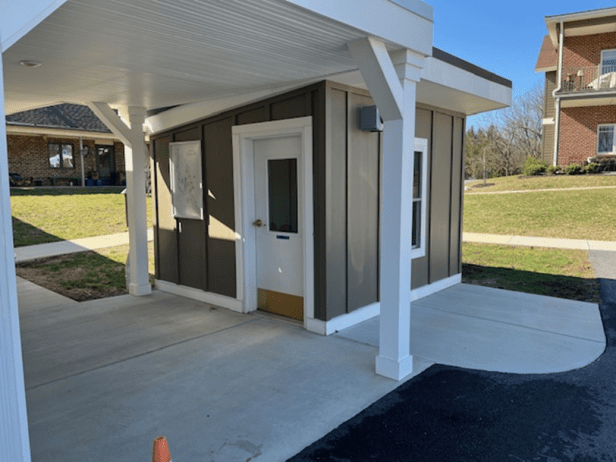
There is no routine on-campus bus service to the Center at Kendal, and there doesn’t seem to be a need for it. Parking near the Center is rarely a problem.
Mobility aids and walking distance. Many IL residents on both campuses make use of mobility aids, which include canes or walking sticks, walkers, motorized wheelchairs, and 3-wheeled motorized “scooters”. But I believe there is a significant difference in how these devices are used on each campus. At Kendal, there are more than a dozen IL residents who find motorized mobility aids essential in getting to and from the Center. If it were not for the covered walkways, some of them would no doubt need to be in the personal care facility (Cumberland) because they would not have a way to get to the Center.
For many Crosslands IL residents, however, mobility aids may not be usable when the weather is bad. Some residents live in apartments or cottages near the Center, with only one short unprotected stretch where they cross the road. For them, mobility aids may be adequate, even in rain or snow. For some of the rest, driving or taking the bus may be the only options in bad weather.
This is not to imply that Crosslands residents routinely drive to the Center. Most don’t, even when the weather is poor. But weather is definitely more of a consideration for Crosslands residents than for Kendal residents.
There are similar issues for non-drivers. At Kendal, in addition to those using motorized aids, there are at least a half dozen IL residents who no longer drive but who walk to the Center every day. For them, the relatively short walking distance to the Center (as well as the covered walkways) mean it is possible to continue living in their cottages, rather than moving to Cumberland. For many Crosslands residents, walking or taking the the bus are the only options once they stop driving, if they want to remain in their cottages–and for many, walking is not practical.
Both of these factors—covered walkways and shorter distances—suggest that some Kendal residents might be able to remain in their cottages longer than some Crosslands residents whose cottages aren’t close to the Center.
It may also be easier for these Kendal residents to attend events in person in their Center, especially evening events. (This difference in accessibility may also help explain why the in-house closed-circuit TV channel plays a central role at Crosslands, but a marginal one at Kendal. Many Kendal IL residents are not even aware of the channel’s existence, and some cottages do not have the necessary wiring.)
On the other hand, it is also possible that having bus service or having a car with a parking spot near the cottage door might enable some Crosslands residents to remain in their cottages longer than those Kendal residents who would have a relatively long walk to get to either the Center or their parked car.
Given the above, it might seem logical that the difference in walking and driving at the two campuses might result in a difference in health. That, in turn, might show up as a difference in the age at which residents move to personal care, or in their age at death.
I have a little bit of data from the voter rolls about the population on both campuses in late 2001 and in early 2025. I was hoping it would shed light on any difference in timing of the move to personal care, but I find it is inconclusive. Similarly, checking to see who has disappeared from the voter rolls during the intervening years can provide a rough guide to residents’ age at death. But that, too, shows no significant difference between the campuses. (On both campuses, it seems to average around 90.)
So what does all this prove? To me, the striking thing about these comparisons is how different the transportation needs of the two campuses have turned out to be. Kendal leans toward walking, with walking aids and scooters used on covered walkways. Crosslands leans toward cars and buses. I don’t think this was planned. It was simply the inevitable consequence of the topography of the two sites. In turn, the difference in transportation styles seems to have affected the social life of each campus to some degree. However, it’s not clear from the data I have in hand that this difference has any impact on the health trajectory or longevity of residents.
 On the Kendal Journey
A very interesting piece, George (erven though it isn’t relevant to me). Love, Dave
LikeLike
Thanks, George. You answered a question I’ve often heard asked: why are Crosslands cottages laid out so differently? Appreciate the insights!
LikeLike
George, I share with you the thought “geography is destiny” but I see the impact of the two site plans as more extensive than you depict: A resident’s selection of community may be based in part on his/her comfort with the site plan. That makes for some of the differences in the “feel” of the communities and the way residents interact or don’t interact with each other in each.Brigitte
LikeLike