
This is the story of a company that started from practically nothing, thrived, and ultimately sold for millions of dollars, all while following a trajectory that was quite unlike what you might read about in books on entrepreneurship or Harvard business case studies. That makes it a story well worth telling. It reminds us that the standard recipes for business success are not a good fit for every business.
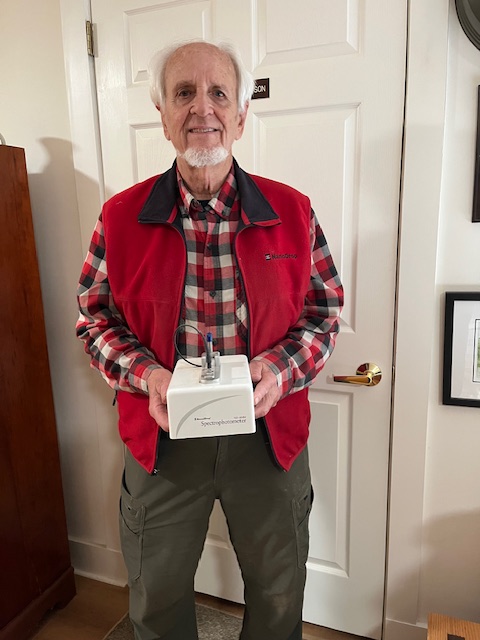
The story starts in 1997, when Charles Robertson (now a Kendal resident) joined a group at DuPont that was studying the genetics of corn and soybeans, with an eye toward developing improved varieties. To analyze the content of fluids, the DuPont researchers used spectrophotometers, a very common type of laboratory instrument. (I used them myself in college biochemistry classes and, subsequently, in grad school.) These instruments work by detecting what wavelengths of light (visible and ultraviolet) are absorbed by the sample. That absorption spectrum provides information about chemical nature of the material in the sample.
A solution to the problem of small samples. A colleague made Charles aware of a problem that the spectrophotometers weren’t handling well. When dealing with solutions of DNA or RNA, the genetic material in the nucleus of the cell, the amounts available for analysis were tiny. A typical spectrophotometer used a small test tube called a “cuvette” to contain the solution being analyzed. The smallest available cuvettes required around a teaspoon of liquid, and they had to be scrupulously cleaned between uses, or sample-to-sample contamination could be likely.
Charles’ colleague told him that she needed to be able to analyze samples of 2µL (a hundredth of a teaspoon)—far too small for existing spectrophotometers.
At the time, there were new components coming onto the market that used fiber optics to convey and measure small bundles of light, and Charles thought an instrument based on fiber optics might be possible. He considered using a tiny chamber with fiber optics built into its walls. But that would have entailed a difficult cleaning problem: every trace of the sample (and its solvent) would have to be removed before the next sample could be analyzed.
But then Charles noticed how a droplet of water could be pulled into a tiny column between a wet thumb and forefinger. Surface tension kept it from breaking up until the gap reached about 1/8 of an inch. Suppose, instead of fingers, the droplet was held between two strands of fiber optics, simply by surface tension. Could its absorption be analyzed without use a cuvette, or any container at all? It turned out to be possible.

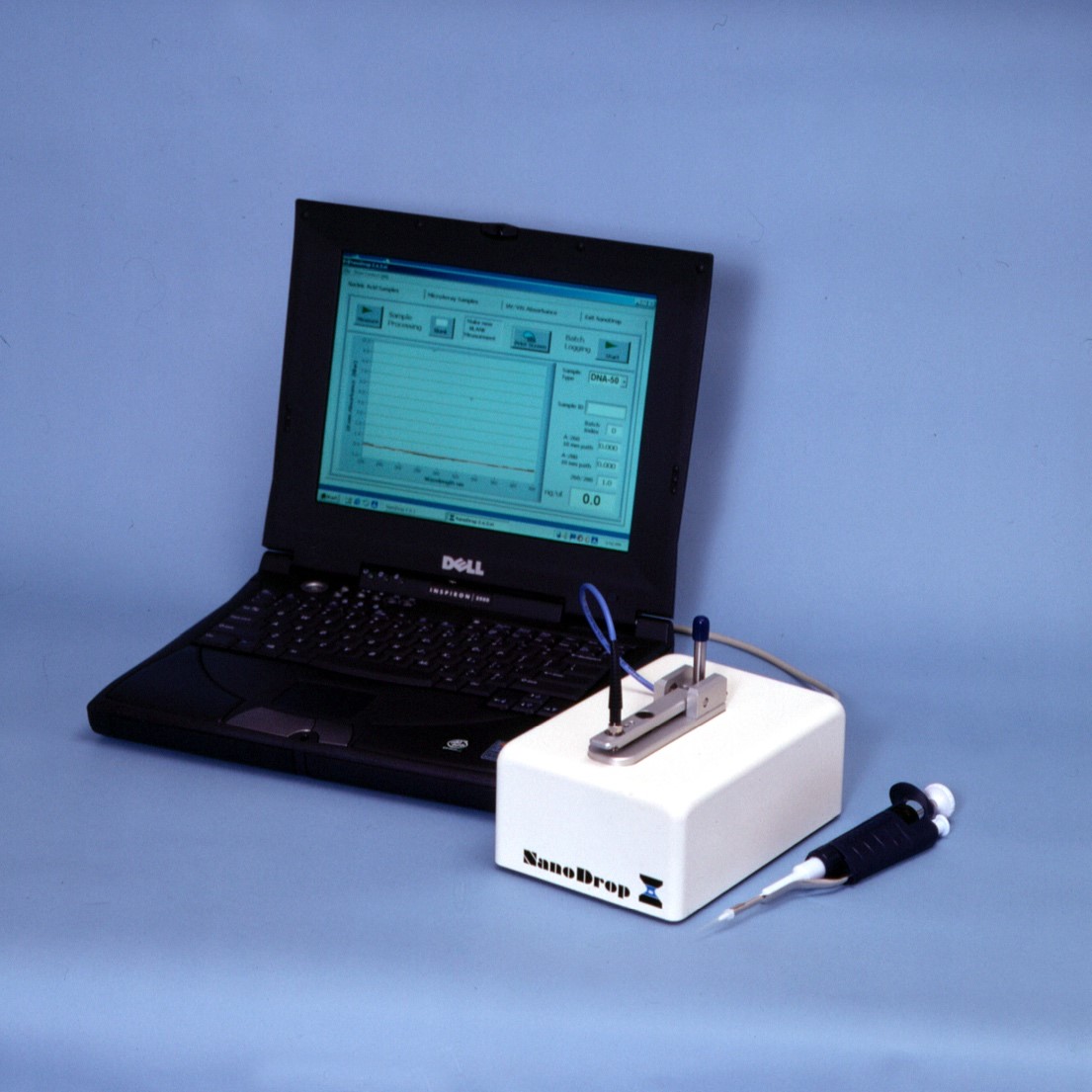
Charles constructed a crude prototype device and invited researchers to try it out. It proved both accurate and popular. Encouraged by that success, Charles developed a more commercial-looking prototype, enclosed in a sheet metal housing. That one joined other shared devices in the group’s “instrument room”. The instrument worked quickly, and cleaning of the contact surfaces with a lab wipe was the only preparation needed between samples.
Charles started working on a patent application, and he sought possible interest in commercialization by DuPont. But, as he puts it, “there seemed to be little interest in DuPont for the instrument concept; it seemed to many to be a simple extension of common laboratory practice.” In a sense, that was true: it did the same job as other spectrophotometers, just more quickly and with much smaller samples. But Charles sensed it had the potential for widespread adoption. He applied for an “intellectual property release” from DuPont, giving him the rights to the technology. He received it in August 1999.

Operating principle of the NanoDrop® spectrophotometer. First a, micropipette is used to deposit a precise amount of liquid on the sample platform (left). Then, the upper part is brought close enough for surface tension to form a bridge between the upper and lower parts. A separation of precisely 1mm is created. The sample is illuminated from the top, and the spectrum is detected underneath (middle). In some cases, a smaller separation is used (right).
The device was constructed from commercially-available materials. One critical piece was the “spectrometer”, the part responsible for sensing the light passing through the sample. Charles found a suitable supplier, Ocean Optics, and would continue to buy their spectrometers for many years as a NanoDrop® component.
The business begins. Qiagen, a German supplier to the DNA research community with headquarters in Hilden Germany, took an interest in the device Charles was developing, and in late summer 2000, two of their engineers visited him at his home workshop. In September, Qiagen placed an order for the first two commercial NanoDrop® devices. While Charles worked on developing the NanoDrop® instrument in his spare time, he continued fulltime employment working on other projects at DuPont.
Charles saw that creating a business entity was needed. He approached a former Dupont colleague, Lynne Kielhorn, who had recently gotten an MBA from Wharton. Charles thought she might have some classmates who would be interested. It turned out that Lynne and her husband Fred were both very interested in becoming partners in the business. Lynne and Fred invited Charles and Pat for a backyard barbeque and the two couples decided on the spot to form a company to develop Charles’ device. The business was incorporated in October 2000 as “NanoDrop Technologies”, with ownership split evenly four ways between the Kielhorns and the Robertsons.
A different business strategy. At this stage, the typical entrepreneurial story would involve a search for investors and an early round of funding for product development. That early capital would be used to pay the principals and get the initial products done.
The two couples, now business partners, decided on a different approach. Each couple put in $17,000 for initial expenses, and they all kept their existing positions. NanoDrop would be a “side gig” and no one would draw a salary in the early going.
They were fortunate in that they had all the necessary skills for their embryonic business: Charles had the ideas and the engineering skills to implement them, Lynne had a background in market analysis and business development, Fred had systems and IT experience, and Pat had an HR background and knew how to run an office. And, of course, they all had networks of useful connections from their previous jobs.
At first, their strategy was to develop the technology, then sell it to another company with the resources to commercialize and market it. Qiagen seemed like a good prospect, but after lengthy negotiations, no agreement could be reached, and the two couples decided to develop and market the instrument themselves. That meant finding vendors for the necessary parts and figuring out how to package and ship the units.
There were plans to develop a housing that was more modern-looking than the white-painted aluminum “brick” that housed the prototype, but these plans were shelved and a new design never was produced.
The first shipments. The first two NanoDrop® units that were completed went to Qiagen (one to a California office, and the other to Germany). The instrument was intended to be trivially easy to set up, so Charles was surprised to get a call from Qiagen’s German office asking him to come and install the device. He made the trip, bringing Pat with him, only to find that the machine was already being used and there was no installation to do. He did, however, pick up some useful ideas for software improvements (and he and Pat got a nice vacation).
The next two devices went to Jefferson Hospital in Philadelphia and to a lab in Scotland where a former DuPont user worked.
Over the ensuing year, sales were slow. All four owners were still working fulltime jobs and working on NanoDrop in their spare time. Lynne was still trying to find a larger partner or purchaser for the company. Charles worked on improving the software, and Fred made improvements to what had been a primitive website. The embryonic company took its machine to trade shows and issued press releases, but there was no paid advertising.
A sales breakthrough. A postdoctoral researcher at the University of Michigan requested a loaner NanoDrop® unit to see whether it was appropriate for his research. He agreed that, in exchange, he would post a report on a popular molecular biology listserve when he completed his evaluation. The report was very positive, and the NanoDrop website experienced a spike in visits as a result. (The date of that spike, 9/11/2001, was to become known for a very different reason.)
By the end of 2001, sales had reached around $200,000.
2002 was a year of major growth. Over 100 units had been shipped by the middle of the year, and the company (which had been operating out of the two couples’ homes) needed real offices. They found space in an old mill building north of Wilmington.
Around this time, each of them phased out of their previous jobs. Charles cut back to part time at DuPont, then retired. Pat retired too. Lynne gradually reduced her consulting work. Fred resigned from his DuPont position.
They also began hiring employees. When they got four excellent candidates in response to an ad for a customer service person, they decided to hire all four (in anticipation of NanoDrop’s rapid growth). It was a good move: three of the four remained with the company (or an associated business) for 20 years.
During this period, two purchase offers were considered, but the proposed purchase prices seemed too low. The couples turned down both offers. They expected that they could make a similar amount in profits simply by continuing to run the business, and that turned out to be true.
Cash crunch. By 2003, NanoDrop was growing rapidly (roughly 2.5X, year over year). The expenses associated with building and selling the additional units began to outrun the income from payments for units that had been shipped. Pat Robertson was able to come up with a solution: she negotiated longer payment terms (90 days instead of 30 days) with Ocean Optics, a primary supplier; and in that extra time, incoming customer payments were sufficient to pay the bills.
Growth and expansion. NanoDrop gradually added employees and partnerships to keep up with growth. The company found a good resource for software development, relieving Charles of that aspect of product development. NanoDrop hired a person Charles had known from DuPont to help with electronic design and another to help with chemistry.
By 2004, NanoDrop had outgrown its space and moved again, this time to an office building north of Wilmington off of Route 202. Over the following three years, the company would expand to occupy most of the building’s first floor.
In 2005, a second NanoDrop product was added: a fluorometer. This was an instrument for measuring fluorescence, another approach to analyzing the substances suspended in a liquid sample. This device, which used the same basic mechanism as the original NanoDrop, turned out to be able to measure even lower levels of fluorescence than expected.
Lynne Kielhorn handled marketing, which now included full page, full color ads in prominent journals, including Science magazine. NanoDrop had hit the big time. Fred Kielhorn managed sales, which involved a combination of direct sales from NanoDrop headquarters and overseas sales through distributors. Pat ran the office, and Charles continued to lead the engineering team.
At one point, NanoDrop had instruments on all continents. This occurred when NASA’s “extreme biology” group borrowed a NanoDrop® spectrophotometer to use in Antarctica. They used it to analyze the life forms they found when they drilled down to the lakes underneath the Antarctic ice sheets.
Throughout this growth, NanoDrop did not experience serious competition. This seems to have been due to a combination of factors: good patent protection, a competitive price, and deceptively tricky engineering issues concerning the required sample optics.
By 2006, NanoDrop had annual sales of $34 million. It was still a relatively small company, with fewer than 35 employees.
The NanoDrop® spectrophotometer was rapidly becoming standard laboratory equipment for every lab doing biochemical analysis around the world.
Sale to Thermo Fisher Scientific. Although NanoDrop had turned down multiple purchase offers over the years, the partners decided in 2007 that it was time to put the company up for sale. One issue that led to the decision was that NanoDrop had outgrown the management style that had taken it to this point. Major decisions had been made Quaker style, requiring consensus among the partners, but with over 30 employees, the company was getting too big for that.
Offers were solicited, and 12 potential purchasers surfaced. Ultimately, a sale agreement with Thermo Fisher Scientific was made in October 2007.
Thermo Fisher Scientific is still selling the NanoDrop® instruments, and while the packaging is a little slicker, the basic mechanism is still the same as in Charles’ early efforts.
 On the Kendal Journey
Thanks for posting this, George. Charles and Pat are a loving, generous couple, and we are lucky to have them in our community. It’s quite special to know the inventor of a tool used by the scientists in our family, with whom I will share your post.
LikeLike
Wonderful and well written article! Thank you for these occasional profiles. Francesca Calderone-Steichen, MPHHead, Estate of Edward Steichen: http://www.edwardsteichen.com Calderone Prize in Public Health, Columbia Univ. Mailman SPH Drs. Frank and Mary Calderone City Health Award, Columbia Univ. Mailman SPH
LikeLike
Thank you for this Charlie had told me a litt
LikeLike