
Earlier this year, I had heard a lot about Abundance, a book by Ezra Klein and Derek Thompson published in early 2025. Ezra Klein himself has been in the news a lot lately, especially concerning his views on what Democrats should be doing to oppose Trump. I decided I needed to read the book, and this post is a summary of my impressions.
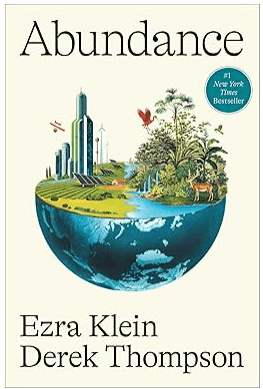
I found the book both fascinating and frustrating. It is full of interesting ideas and insights into past events. But (despite initial appearances) it does not seem well organized and its conclusions are surprisingly weak.
If the book has an overall theme, it is the effort to determine what the government should and should not be involved in. The government could focus on a policy of “abundance” but that would have to be an explicit choice, with political follow-up.
The authors conclude that neither the liberals nor the conservatives have the right viewpoint on the government’s role. They write: “We are stuck between a progressive movement that is too afraid of growth and a conservative movement that is allergic to government intervention.” To get the government to take on the kinds of big projects that only it can handle, the liberals need to back off on over-regulation and the conservatives need to be more willing to support government programs.
Good examples of big-government program successes include the interstate highway system, the moon landing, and the rapid development of the Covid vaccine.
Four big areas for improvement. The book is dominated by the authors’ examination of four areas that are in desperate need of help: the housing shortage, the climate crisis and the need for electrification, the failure of US science policy, and the lack of support for invention and innovation.
Each of these topics is placed in a historical and international context, and many of the issues that led to the current state are brought to light. For example, homelessness and lack of affordable housing are correlated, and the authors make a strong case that in fact housing affordability is a major factor in causing homelessness. Beyond that, they point to restrictive zoning and tax policies as the factors that undermine affordability.
They cite “lawn-sign liberalism” as an indicator of the failure of liberals to face the consequences of some of their choices: lawn signs favoring affordable housing and other programs to help the underserved often appear on the lawns of houses in highly-zoned areas where affordable housing is impossible to build.
Regulatory gridlock. The systems of regulation that brought us a cleaner environment over the course of the last fifty years are now becoming obstacles to progress. California will probably never get its promised high-speed rail system because regulations and lawsuits will prevent it. This is one example among many that the authors present.
Both liberals and conservatives are now experts at using regulations and lawsuits to stop whatever they currently don’t like. It has taken 16 years, and will take two more years at a minimum, to get through the regulatory process to build a big windfarm on federal land in Wyoming.
Our environment can’t afford that slow pace. Liberals need to recognize that tradeoffs must be made between how they would ideally like things done and how to get things done efficiently enough to solve our climate crisis. The authors quote Michael Gerrard, founder of Columbia Law School Sabin Center for Climate Change Law: “It is too late to preserve everything we consider precious.”
Government needs to step in where business won’t. Our government has turned over all big projects to private industry. That’s not working very well. In China, by contrast, the government has a vision of the future and uses its clout to move industry toward that future. We need a bit more of that in the US.
Can we manage that? Well, sometimes. The Covid vaccine program shows how. So does the actions by Pennsylvania Governor Shapiro when bridge damage from a burning tanker truck threatened to shut down Interstate 95 for months. Shapiro declared an emergency and ordered steps that bypassed the normal bidding process. He was able to get the highway running again in 12 days. The DARPA agency also has a strong track record for getting innovative projects done.
But the Covid vaccine, the I-95 bridge repair, and DARPA are rare exceptions. There are very few examples of long-term government actions that end up in major improvements. The authors dig into the reasons for that, and they have some suggestions, particularly in the areas of scientific research and in creating markets for innovative products.
A disappointing ending. The book is well written, but it doesn’t really have a sense of direction. It switches among themes and examples in a way that feels as if it was thrown together without enough thought for organization.
I was hoping that, given the promising material sprinkled throughout it, the book would have a strong ending, with a set of principles based on what the authors had discovered.
I was disappointed. The authors say that Trump won the election, not because he brought a vision, but because he could point to liberalism’s failures. Liberals, therefore, have the opportunity fix that situation. But how? There is little here beyond a few general suggestions, such as recognizing that abundance requires tradeoffs and refusing to buy into ideas of scarcity.
Instead of specific ideas, the book offers some principles, and the questions they generate. With respect to housing: “What is ultimately at stake here are our values. How do we weight the role that the current inhabitants of a community should have in who enters that community next? How do we balance the interests of a town against the interests of a country?”
The authors ask, “Can we solve our problems with supply? If there are not enough homes, can we make more? If not why not?” They pose the same questions for clean energy, for constructing major projects on time, and for the factors that bog down scientific progress.
As for the current political situation, the authors speculate that we may be at the turning point of a “political order” like the one FDR initiated with his New Deal or the “neoliberal” order that Regan initiated. If we are at such a turning point, how can we seize the moment? The book does not provide an answer.
The authors write: “Political movements succeed when they build a vision of the future that is imbued with the virtues of the past.” FDR and Regan both did that. Maybe we can too, if we figure out how and find the right spokesperson. But to do that, we’re on our own. This book doesn’t tells us how.
 On the Kendal Journey