
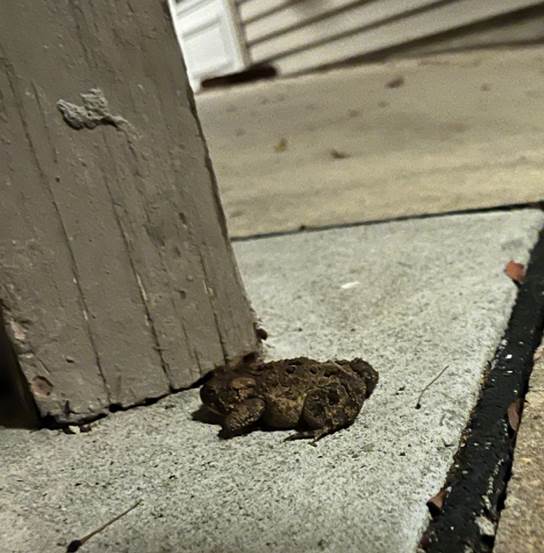
Last evening (September 16, 2025) I encountered a dead toad on one of our outdoor covered walkways. It was the first toad (living or dead) that I had seen since September 5, and I have reason to think it may be the last one I’ll ever see here at Kendal.
Why do I think it may be the last? Well, there’s a bit of a story behind that.
Toad counting. Starting after our arrival in May of 2019, my wife Jan and I would go out at night and take a walk on Kendal’s covered, lighted walkways. We frequently encountered toads—often 5 or 6 and sometimes more than 10.
By the summer of 2020 (with Covid in full force), we took to counting the toads as a form of recreation. Covid caused severe restrictions on social interactions, and counting toads each evening was a way to pass the time, with a walk when no one else was around. We developed a standard circuit of walkways (our “Toad Loop”) and recorded the toads we saw, including the address numbers of the cottages they were crouched in front of. By July of 2020, we had established a recording sheet for the toads we observed.
On warm nights, we knew we would always encounter toads. They came out on summer nights, enjoying the residual warmth of the day emanating from the cement walkways and picking off bugs drawn to the walkway lights.
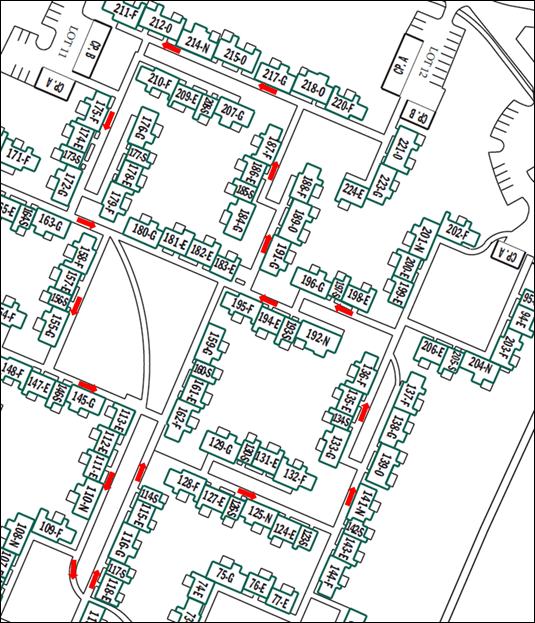
Our Toad Loop took 15-20 minutes to walk. We generally walked it between 8:30 and 9:30 in the evening. The map below shows where it went.
We walked it most nights, except when we were away from campus. In recent years, I’ve continued walking the loop, but Jan has had other priorities, so I’m mostly on my own now.
It isn’t hard to spot the toads. They are sedentary creatures and prefer not to move unless it seems essential. You can pass within a few inches of one and often it will continue to just sit there. Frogs, on the other hand (and we have spotted a handful of those, too) are lithe, athletic creatures which leap away when they see us coming. But the warty, bulbous toads tend to stay put.
Normally, toads are solitary and silent. For a few days in the spring, that changes. They migrate to their home pond (which, in our case, is the holding pond for treated water after it leaves our waste treatment facility) and engage in a wild mating ritual. Hundreds of them line the shores of the pond, climbing onto each other and croaking enthusiastically. Jan and I were fortunate enough to happen by the pond during this amazing scene a couple of years ago. (You can get a sense of what it is like by watching this remarkable six-minute Swiss film about the human-assisted migration of some toads to their ancestral pond.)
But I am not sure if the migration and mating happened this year. Lately, the toads (and frogs) have been disappearing.
Disappearing toads. When I created a spreadsheet from our Toad Loop tallies, I was able to document a severe drop in the number of toads in the last two years. (I admit it: compiling a spreadsheet of five years of toad sitings is a little weird.)
A good way to express the changing numbers is in terms of the average number of toads that we encountered in one circuit of our Toad Loop. The chart below shows how the numbers have dropped off.
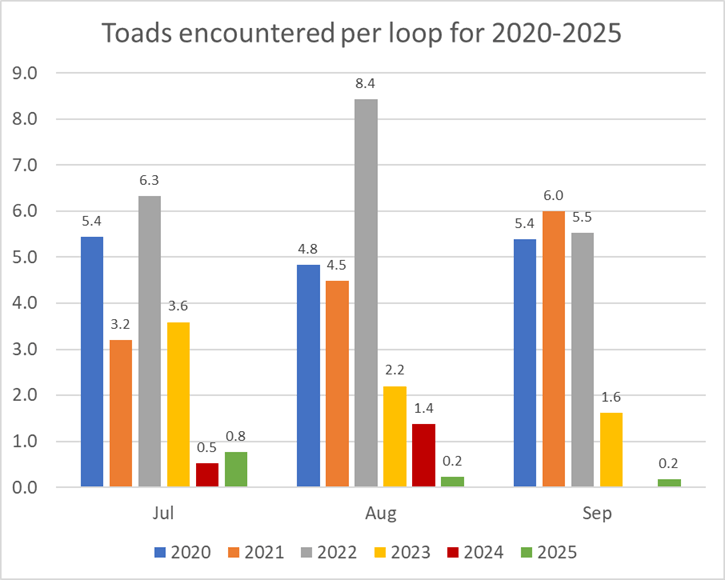
If you look, for example, at the month of July: in 2020 we saw an average of 5.4 toads each time we walked the Toad Loop, in 2021 we saw 3.2 per loop, in 2022 we saw 6.3, and in 2023 we saw 3.6. But in 2024 and 2025, we saw only 0.5 and 0.8 respectively (the short red and green bars). The drop-offs for August and September were even more dramatic. (The 2024 figure for September is missing because we were away that month.)
These year-to-year losses are so great that it seems probable that not enough toads will survive to breed and keep the local population from dying out.
What is happening to the toads? I don’t know why the toads have disappeared. I don’t think it’s the changing climate: that type of change is too slow to cause such an abrupt drop in the numbers. I don’t think it is a local environmental change (like something in the pond water where they breed). Surely other wildlife would be affected if it was something like that, and I haven’t noticed an impact on other animals or plants.
One plausible cause of the decline is a fungus called Batrachochytrium dendrobatidis. It is causing declines in many amphibian populations around the world. If that is the problem, our local toad population may never recover. Toads in captivity can be saved from the fungus, but not those in the wild.
But there are other possible causes. A good summary is here: https://armi.usgs.gov/sota/
As the weather cools down, I don’t expect to see any more toads this year. I’ll plan on checking next summer, and I’ll post an update if toads start showing up again.
 On the Kendal Journey
Interesting. Poor little toads . I hope they recover in numbers .
LikeLike
What a teaser. Why do you have reason to think it might be the last toad you’ll see here at Kendal? Is it because of the pesticides and herbicides they insist on using on the grass in the cottage areas — the poisons that prevent me from harvesting dandelion greens for a French inspired gallete I used to enjoy making? I am not the only one here who deplore this destruction of habitat. Barbara Hallowell was the champion for dandelion greens. I miss her.
And, yes, I used to see many toads at Kendal.
Tom
LikeLike
If we lose too many toads, there won’t be a breeding population any more. That’s why I think we may have seen the last of them. It could be the herbicides that are at fault, but I think the fungus is more likely.
— G
LikeLike
After having trouble with the commenting feature, Arlene Rengert sent me the following comment to post:
George, I am remembering that your documentation of toad life at Kendal dates at least to 2020 when your brief poem and picture appeared in the Kendal Haiku volume. See page 5 in the attached portrayal of Kendal in Spring. The spiral-bound volume is in the Kendal Library. Arlene
The Haiku in question was:
Warmer nights are here
And the toads are returning
Slugs will join them soon
LikeLike