
Every summer, KCC requests an analysis of our long-term financial prospects from our actuarial firm, A. V. Powell (AVP). To support that analysis, we provide AVP with data about our finances and financial projections, our facilities, and the demographics of every resident. (They use the demographic information to estimate our future healthcare needs.) AVP provides us with an actuarial report and a set of comparisons with other CCRCs.
This year, at KCC’s request, AVP provided a comparison of the net financial cost/benefit to KCC from the different types of housing that we offer. Ed Plasha, KCC’s CFO, reviewed this data briefly at the end of his annual budget presentation on November 24, 2025 (you can watch the video here).
The results are striking.
Studio cottages are the smallest (and cheapest) form of housing at Kendal. (Studios are only available at Kendal—there are none at Crosslands.) In the annual “Act 82 Disclosure” document that every resident receives, the entrance fee and monthly rental fee for each type of housing is listed. As of 1/1/2025 the entrance fee for studios is $99,000; the monthly rental is $3,872. But how do those fees compare with what it costs KCC to accommodate those studio residents? That is the question that AVP set out to answer—not just for studios, but for each of our housing types.
Many of the costs that AVP considered are the same, regardless of housing type. That includes the really big item—health care—but also food and each resident’s share of the overall cost of running KCC. Some costs are less for smaller units simply because they are smaller, especially utilities and cleaning, and AVP did take that into account.
The results of AVP’s analysis are shown in the chart below. It shows that KCC’s “margin” (which could be thought of as the “profit” KCC makes on each resident’s payments) is actually negative for studios and one-bedroom units. For studios, it is around -24%. Stated differently, if KCC wanted to break even on studios, it would have to charge 24% more (in terms of some combination of entrance and monthly fees). And, as Ed Plasha points out, even if KCC wanted to charge that much more, those units would not be marketable at those rates.
Note also that one-bedroom cottages are also priced below breakeven, though not by as much.
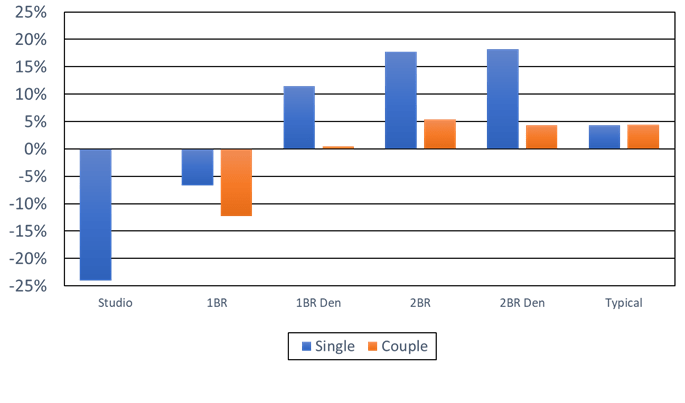
KCC offers studio units (and, to a lesser extent, one-bedroom units) at a bit of a deficit. It is able to do this because it offers larger ones at a slight surplus. This is in line with what Kendal’s founders intended, and it is probably what KCC has always done. We just haven’t seen the data to confirm it until now.
It is possible that AVP has not fully accounted for some aspects of studios that cause them to have lower expenses. For example, studios generally have very small lawn areas, and they don’t have driveways that need plowing and occasional repaving (like those of the Kendal East duplexes). But these costs are relatively small and are unlikely to change the overall conclusion: there is a cross-subsidy between unit sizes.
Ed Plasha, in his presentation, emphasized that studio residents pay “their fair share”, in the sense that the studio fees are in line with what residents would pay for the equivalent unit at other retirement communities, but so are our fees for larger units.
A few years ago, Kendal’s studio-dwellers made a pitch to our administration, requesting that the existing 24 studios be preserved (i.e. that the practice of combining studios with adjacent units, which had eliminated about half of the original studios at Kendal and all of them at Crosslands, be stopped). The administration agreed to that, and we still have all 24 studios. In fact, we have gained one: among the new apartments underneath the health wing expansion is one studio apartment.
I like to think that most residents in the larger units are happy to know that a bit of their monthly rent makes it possible to have 25 studios here. It contributes to the economic diversity of Kendal, and I am struck by the major contributions to life at Kendal that our 25 studio-dwellers make.
I am glad that KCC’s policies make it possible for us to have a significant number of relatively affordable studios. For me, it is reassuring that Kendal can take an approach that is not completely dominated by optimizing our finances. Yes, we much keep our costs under strict control, but there is room for other, non-financial factors to influence the choices we make.
 On the Kendal Journey