
The products and technologies developed by Kendal resident Jim Serum at Hewlett Packard contributed significantly to the creation of Agilent Technologies, a Hewlett-Packard spinoff with billions in sales
The story really begins when Jim, as a young PhD, joined the faculty at Cornell University and was running a lab that did analysis of trace amounts of substances, such as environmental pollutants and drugs. This experience kindled a life-long interest in ways to test trace amounts of chemicals in the environment and in humans and animals. At Cornell, Jim was contacted by a professor from the Cornell Veterinary School to see if he would be interested in developing tests to determine whether race horses in New York had been treated with illegal drugs. Drugs were viewed as an increasing problem in the equestrian competitions. This program was funded and is still active today. Jim joined Hewlett-Packard in 1973 at its facility in Avondale, Pennsylvania, (not far from Kendal) to develop technology based on his research at Cornell. Because of his research on testing for illicit drugs in race horses, Jim developed methodology that was used to test athletes at the 1976 Olympics. Jim’s interest in working with detecting tiny amounts of chemicals naturally led him to an interest in DNA and molecular genetics, and by the late 1980s, he was working on genetic pathways involved in crop diseases, still at HP.
DNA array chips: a tool for rapid DNA analysis. By around 1990, several firms had developed early stage “DNA array chips”—pieces of silicon with different areas holding different bits of single-stranded DNA fragments called “probes”. The idea was that a scientist could take a sample of DNA from an organism of interest, cut up the DNA and break apart the strands, apply the sample to the chip, and see where the resulting strands stuck to the chip’s probes. By knowing what probes were where on the chip, a scientist could tell which sequences were in the DNA sample.
For example, one area of the chip might bind DNA that coded for the faulty DNA involved in sickle cell disease. A patient’s blood could easily be tested for the presence of that gene by using a DNA array chip with the corresponding single-stranded DNA.
Hewlett-Packard, where Jim worked, was not involved in making those early DNA array chips, although HP scanners developed by Jim’s team were used to detect the DNA-binding sites in some of the systems, including those of industry leader Affymetrix.
A role for inkjet technology? In 1993, an engineer on Jim’s team inquired whether ink-jet printing (already a Hewlett-Packard specialty) could be used to precisely place tiny amounts of single-stranded DNA on the chips. The placement method used by Affymetrix at the time required the use of a “mask” produced by a photographic process. The “bases” (A, C, G, and T—Adenine, Cytosine, Guanine, and Thymine) that make up the genetic code would be added to the chip based on the unmasked areas.
So, for example, a mask could be created that exposed only the parts of the chip that required the addition of the base “C”. Once the C bases were attached in the desired places, the mask was removed and the process repeated for the other bases. In this way, short strands of DNA were built up, a base at a time, on the chip.
That method worked, but it was inflexible. All the very precise photographic masks for a chip with specific DNA strands had to be created in advance in a tedious process. To develop a chip that tested for different DNA required a completely different set of masks.
The question was whether a competing, more flexible method of DNA array manufacturing could be developed using inkjet technology.
The Challenges. Jim was intrigued by the possibility of using HP’s inkjet expertise to place single-stranded DNA on silicon chips. The chips themselves were not a problem: they were produced in large quantities and very high purity for producing integrated circuits. In this case, no circuits would be needed, but the blank chips provided an excellent substrate. Jim launched a new biotechnology research program for HP based on this idea. However, there was virtually no knowledge about the science and chemistry involved in creating such a chip. Jim hired engineers who had expertise in attaching molecules to silicon substrates. They had to learn how to do it with nucleic acids (the backbone of DNA).
However, squirting strands of DNA through the inkjet nozzles presented serious difficulties. DNA consists of long, stringy molecules made up of various sequences of the A, C, G, and T bases. When there is a significant concentration of DNA in a solution, the liquid becomes very thick. Even when the DNA was cut down to strings of just 8 or 10 bases, the liquid would not flow smoothly enough to be used with HP’s inkjet technology. The nozzles were constantly getting clogged.
Jim’s team struggled to find a solution to this problem. Instead of squirting short strings of multiple bases, they turned to squirting bases individually. They used an inkjet technique to lay down a series of masks, analogous to the ones used in the earlier photographic process. The process of building up short strings of bases was the same as it had been with photographic masks. But in this case, the mask was created digitally, which meant that it could be different for every chip. Custom chips for any DNA sequence were practical, which opened up whole new research fields.
A new division? When he believed that a solution existed for each of the technical challenges, Jim thought about how this project might fit into the HP organization and what would be required to get it to market. There was no division within HP that was dedicated to biotechnology, so it was not obvious how to integrate the DNA chip project into the corporation. Jim realized that a new organization was required. He put together a rough business plan and discussed it with his boss. Jim was co-chair of HP’s “Research Council”, a group representing research efforts throughout the company, so Jim was able to solicit input from other knowledgeable colleagues.
He set to work refining the plan. How many people would be required? How many of them would have to be new hires? What kind of budget would be needed for the first year? He recognized that around $10.5 million would have to be spent in getting the prototypes made and the business off the ground.
He also needed to be able to describe the markets for this technology. That part was not hard: there were obvious medical markets (e.g. detecting genetic problems via blood samples), forensic applications (e.g. matching crime-scene DNA with that of suspects), and many more.
A new division with a big budget was going to require Board-level approval. In 1996, when he felt he was ready, Jim arranged for a presentation to HP’s Board of Directors, arguing for a new HP “Biosciences Division”. The Board was supportive. The CFO suggested that Jim “take $1 million and try it,” but Jim was certain it couldn’t succeed on that basis. He insisted on $10.5 million. The CFO asked, “How many of these systems will you sell?” That question wasn’t answerable without an actual product. The CEO, with whom Jim had worked for many years, told the CFO “You know Jim is right”, and the Borad gave its approval.
Starting up the Biosciences Business Unit. Once he got the go-ahead, Jim immediately started a “skunk works” effort working toward a commercial product. He got other HP employees interested in the project and they helped by (unofficially) contributing their efforts. He also arranged for the new organization called The BioScience Products Group (BSP), to be co-located with HP Labs, the “brainstorming” part of HP (comparable to Bell Labs in New Jersey). This had never been previously attempted. HP Labs was always a separate organization dedicated solely to fundamental research. Jim felt it was vital to be able to tap the creative minds in HP Labs and quickly integrate new research ideas into the prototypes for his new venture.
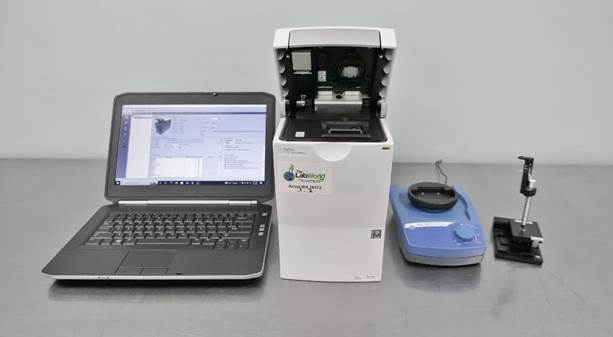
“Serum’s folly”. Due to the almost impossible odds of achieving a working DNA chip based on inkjet technology, some senior managers at HP began referring to the project as “Serum’s Folly”. However, after much initial work in improving the yield of good chips, the early stage DNA Chip product was introduced to the market place.. It offered arrays of customized single-stranded DNA of up to 9 bases in length (subsequently increased to 12 bases). The initial product (the 2100 BioAnalyzer) was a commercial success and the division grew rapidly.
In 1999, the BioScience Products business and a number of other HP businesses were spun off as a separate company under the name Agilent Technologies. In its initial public offering (IPO), Agilent raised $2.1 billion, the largest IPO in Silicon Valley history up to that point. By then, annual revenue was about $8 billion, and there were 43,000 employees—about a third of HP’s entire workforce.
Agilent initially remained an HP subsidiary. But in 2000, HP turned its Agilent shares over to HP’s shareholders, and Agilent became a fully independent company.
The Agilent spinoff included many of the products that Jim helped develop and commercialize. But the product that was most challenging and most rewarding was the DNA Chip. Today that market alone is valued at more than 15 billion dollars.
Agilent went on to make major enhancements and launch new products, eventually including a DNA array chip that could read the whole human genome. But Jim was not involved: he had retired in 1999 to found his own company, called Viaken Systems, which focused on technologies which would cut the time to develop new drugs by half.
—
In researching this article, I was startled to find how little of this history has been retained on the Web. Given the scientific importance of this technology, and given that Agilent quickly became the second-largest purveyor of DNA array chips (after Affymetrix), you would think there would be a lot of information available. While there is plenty of material about the history of Affymetrix, there is almost none about the HP/Agilent story. I hope this blog post, in its limited way, will help to rectify the situation.
 On the Kendal Journey