
Here in the US, we have a polarization problem, and it is fundamental. In particular, we have massive conflicts over the way our federal government is being run. Those conflicts will never be fully resolved until people can talk to each other civilly, person to person. Right now, people’s political positions are so polarized that those conversations rarely take place. But they are urgently needed.
In this blog post, I review three books that address the problem of overcoming the partisanship divide and opening the way for dialog. Although they each have different approaches, all three share two basic philosophies: we need to learn to listen better to what others are saying, and we need to look more carefully at our own strongly-held positions.
The first book, I Never Thought of It That Way by Monica Guzman, is the personal story of a woman living in a largely liberal bubble who came to understand and befriend conservatives. She also learned to appreciate the conservative values of her immigrant parents. The second book, How to Think by Alan Jacobs, is very helpful for understanding the sources of our own biases. The third, Beyond the Politics of Contempt by Douglass Teschner, Beth Malow, and Becky Robinson, presents the model of facilitating dialog between people with opposing political views as pioneered by the national Braver Angels organization. Each book has important lessons and insights for those of us who are seeking a path forward in the context of intractable polarization.
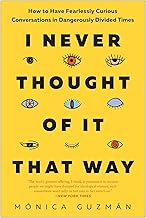
One person’s journey. In I Never Thought of It That Way: How to Have Fearlessly Curious Conversations in Dangerously Divided Times, Seattle journalist Monica Guzman tells her personal story as a liberal daughter of Trump-voting Mexican immigrants, and how she ultimately resolved that family rift. It is also a how-to manual for the rest of us who are trying to understand how our country got to its polarized state, and what we can do about it.
A central theme of the book is to cultivate curiosity. When you encounter someone with beliefs different from your own, ask yourself “what, exactly, does that person believe, and why?” Until you can answer that question—not just to your own satisfaction, but in a way that they agree is correct—you won’t really understand their point of view.
A highlight of the book is its description of a bus trip Guzman helped to organize. A bunch of residents of King County, Oregon (Seattle’s county, where Hilary Clinton won 74% of the vote in 2016) traveled to Sherman County in central Oregon (where Trump won 74% of the vote) to discuss their differences with a group of people pulled together by the Sherman County agricultural agent. It was a mind-opening event on both sides.
Another strong section is Guzman’s chapter on “Values”, in which she comes to a better understanding of her father’s values and, as a result, of his perspective on politics. Guzman reports on research which shows that, while almost everyone shares a set of about 10 values to one degree or another (she lists them as power, achievement, hedonism, stimulation, self-direction, universalism, benevolence, tradition, conformity, and security), there are big differences in how we prioritize among them, and that can explain a lot of our political differences. She provides suggestions for how we can assess our own values and those of others, and the outsize role values play in our political choices.
At various points in the book, Guzman writes in passing of her involvement with the Braver Angels group, but that is not a major theme.
At the end of the book, Guzman describes the time when she decided to join a protest for the first time as a participant, not just as a journalist. The sign she made carried just three words: “honesty, curiosity, respect”. Those words summarize the core message of this book.
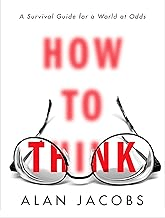
Uncovering your own biases. It is extraordinarily difficult to recognize your own biases. In How to Think: A Survival Guide for a World at Odds, Alan Jacobs provides some tools for doing that. This slim, well-written book predates the Braver Angels movement (it was published in 2017, the year that Braver Angels was launched) and it does not address the question of how to deal with disagreements face-to-face. What it does do is point out the many ways that thinking can be undermined, and how many of the things we “know” can be wrong.
One of the recurring themes of the book is the Repugnant Cultural Other (RCO), the idea of people whose point of view is so foreign to yours that you don’t need to take them seriously—you can make fun of them and gain an instant feeling of superiority. To the extent you classify someone (or a group of people) as RCOs, you have closed off the possibility of understanding where they are coming from.
Another of Jacob’s themes is “the inner ring”, a group of people you really want to be part of—so much so that you don’t think critically about the views they are espousing. Both of these concepts help to explain the impasse that our polarized society has arrived at.
It is all too possible to become a fanatic about an issue, losing all perspective in the process. As Jacobs says, fanaticism means “no matter what happens, it proves my point”.
At the end, Jacobs includes a list he calls “the thinking person’s checklist”. It includes such suggestions as “Gravitate as best you can, in every way you can, toward people who seem to value genuine community and can handle disagreement with equanimity” and “Try to describe others’ positions in the language that they use, without indulging in ‘in-other-wordsing’.”
This book is full of ideas about how to avoid the mental traps that abound in today’s society. But, as Jacobs concedes near the end of the book, “You have to be a certain kind of person to make this book work for you: the kind of person who, at least some of the time, cares more about working toward the truth than about one’s current social position.”
There are such people, on both the liberal and the conservative side of every issue—but not as many and not as vocal as we urgently need.
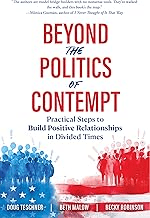
Following the Braver Angels path. Three members of the national Braver Angels group (Douglass Teschner, Beth Malow, and Becky Robinson) have put together an ambitious book that can be thought of as a primer on the Braver Angels approach to resolving our society’s polarization problem. It is called Beyond the Politics of Contempt: Practical Steps to Build Positive Relationships in Divided Times. It has not officially been published yet (that will happen September 5th) but I have been provided with an almost-final draft in PDF form, and that is the basis for this review.
Sprinkled through the book are short examples—just a few paragraphs—of pertinent experiences of each of the three authors. These provide practical illustrations of the key points being made. Each chapter closes with a set of questions called “For Further Thought”, which help the reader apply the lessons of the chapter to their personal situation.
If you want an overview of what Braver Angels does and how you can apply it in your situation, this is the book you need. Many readers will prefer to jump around among the 17 chapters of this book, since it covers a lot of topics and there is a great deal of detail.
A lot of the book deals with polarization and how face-to-face conversations, skillfully used, can begin to overcome it. Social media comes in for heavy criticism. The authors basically agree that it is unrealistic to expect helpful dialog to occur via social media. And of course, there are those who seek to stir up controversy on social media, whether for profit, power, or just feelings of superiority. The authors speak of “conflict entrepreneurs” and “polarization as a business model”.
On the other hand, the authors point to evidence for an “exhausted majority” of people who are tired of the polarization and want a return to something better. The key is to find ways to reach these people and show them their power.
For me, the most valuable chapter of the book (and it has many other valuable chapters as well) came near the end. Its title is “Find your path—think global, act local” and it shows how to use Kurt Lewin’s concept of “force field analysis” to decide what to do. Given a comprehensive list of positive and negative forces affecting the changes you want, what could add to the positive forces? What could reduce the negative ones? There are some great ideas here.
All three of these books are valuable resources right now. Get ahold of them and read them! Our Kendal library already owns “How to Think”, and I have put in a request for the other two.
 On the Kendal Journey
Three perspectives on how to bridge the divide in this country, 24Aug2025
1.
One person’s journey. In I Never Thought of It That Way: How to Have Fearlessly Curious Conversations in Dangerously Divided Times, Seattle journalist Monica Guzman.
Guzman reports on research which shows that, while almost everyone shares a set of about 10 values to one degree or another (she lists them as power, achievement, hedonism, stimulation, self-direction, universalism, benevolence, tradition, conformity, and security), there are big differences in how we prioritize among them, and that can explain a lot of our political differences.
One line of the blog— “the outsize role values play in our political choices.”
2.
Reminded me of a definition of “politics” from a grad school political science course:
‘Politics is the authoritative allocation of values.”
Internet search discloses the author:
“The phrase “politics is the authoritative allocation of values” was coined by the American political scientist
David Easton. He defined politics in this way to provide a consistent and scientific framework for understanding political systems as the process of distributing rewards and enforcing decisions within a society. “
From David Easton’s apparent perspective, of course, values plays a major role in politics.
3.
Timothy Snyder discusses values in his good 2024 book, “On Freedom.”
“Freedom is the value of values. . .” (page 53)
I’m not here trying to abstract Synder’s book, but to suggest Guzman may not appreciate the
value of values in politics, and to suggest both Snyer’s book, On Tyranny and On Freedom
are well worth reading.
LikeLike
Thank you so much for the kind words about our book. Two of us are local and would love to come talk at Kendal!
LikeLike