
Thanks to Em Brown and Lindsay Eidson in the Facilities Department, I recently received data about the use of the KCC EV charging facilities during 2025. There is a lot of interesting information in the data, plus some grounds for concern.
Despite the fact that most residents with EVs (including plug-in hybrid EVs) have very inexpensive access to charging where they park, use of the central EV chargers continues to grow. There are two charging “towers” with two plugs each at the Kendal barn, and the same configuration at the Crosslands Center, which means that up to four EVs could be charging simultaneously on each campus.
Central chargers vs. parking-area plugs. Many of those using the central chargers are staff members and visitors, and that’s a good thing. We are providing a service at below-market rates ($0.30/kWh) for those groups.
But quite a few residents use the central chargers too. In almost all cases, getting electricity from the regular outlets in their parking areas would be cheaper. (To get access to a standard 110v outlet, KCC charges just $10/month for plug-in hybrids and $20/month for full battery-electric EVs.)
Given the expense, it’s worth explaining why residents would choose to use the central chargers despite their cost. The motivation is speed of charging. Plugging into the “Level 2” central chargers is about 10 times as fast as a regular outlet. An overnight charge in a regular outlet will give you about 40 miles of range. If you have a significant daily commute (as some residents still do), that won’t be enough. If your EV’s battery is depleted and you want to fill it quickly for a trip of 150 miles, you can’t charge from a standard outlet (which would take several days).
Most visitors and staff members don’t have access to a regular outlet for charging, so the central chargers are their only choice.
The remainder of this post is about central charging. As far as I know, we don’t have any detailed data about the charging that residents do using their parking-lot outlets.
Chargers and charging growth. KCC purchased its central chargers in 2020. Half of the cost was paid by a state program which was funded by the “dieselgate” settlement (under which VW paid heavy fines for cheating on the exhaust testing of its diesel cars). The chargers came from ChargePoint, which continues to run the system that handles credit-card payments for charging. KCC sets the fees, not ChargePoint. The $0.30/kWh fee is significantly higher than the roughly $0.10/kWh that KCC pays for the electricity, but still a bargain compared to commercial chargers elsewhere. ChargePoint takes a small cut for handling the payments.
Each year, use of the chargers has grown. In 2025 there were 1,056 charging sessions involving 61 different vehicles. The total amount of electricity used in charging was 16,345 kWh (a bit more than one thousandth of our overall electricity usage). Charging fees earned KCC about $4,900.
In 2025, for the first time, there was more charging at Crosslands than at Kendal. Several factors could be involved, but it is likely that Crosslands has some new EVs (whether owned by residents or staff). Charging volume continued to grow over the course of the year, as shown in the chart below.
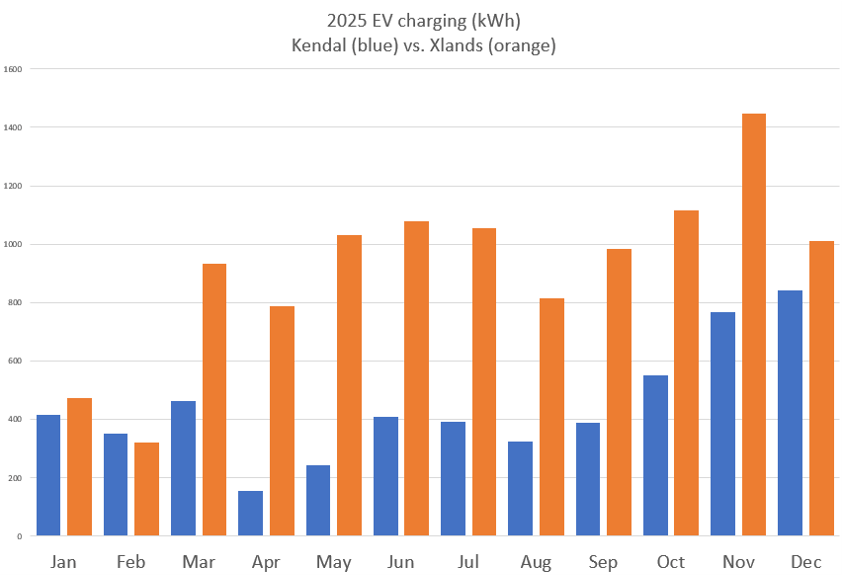
Of the 61 vehicles that used the chargers, just four had over 100 charging sessions in 2025. The median vehicle had only 4 charging sessions, and 20 vehicles had just a single session (those were likely to be visitor vehicles).
Do we need more chargers? I was interested in learning whether growing charger use meant we were running out of capacity. Might an EV arrive at one of the central chargers, only to find that all four charging spaces were occupied?
To answer that question, I first looked at the number of charging sessions for each day of the year, on each campus. If there were less than four sessions on a given campus, there would not have been a charging capacity problem on that day, since each campus can charge four vehicles at once. I found that there were 33 days with four or more charging sessions at Crosslands, and just 7 such days at Kendal.
I next looked at the timing of each of those sessions, to see the amount of overlap. The charging data shows the start and end time (when the charging cable is disconnected) for each session. As it turns out, there were a few periods of three overlapping charging sessions, but no period when all for charging ports were in use, on either campus. That suggests that KCC is nearing the point of needing more chargers, but hasn’t gotten there yet.
Clouding this issue is the fact that, at Crosslands, the chargers are installed in a location that is desirable for anyone wanting to park at the Center. There is signage indicating that the four charging spots are reserved for EVs, but non-EVs have frequently been observed parking there. (The Kendal chargers, tucked away near the barn, are less likely to be used by non-EVs. I glance at them as I drive by, and I have never seen vehicles parked in all four of them at once.)
What about those “zero kWh” sessions? One unexpected feature of the data is that there are many sessions with 0.0 kWh (no charging at all). There were 36 such sessions, 29 at Crosslands and 7 at Kendal. In these cases, the user must have been able to sign into the ChargePoint charger, because that is what creates the record of a session. (When you sign up for ChargePoint’s system, you receive a small key-ring card, similar to the small cards KCC issues for charging meals. Signing in just requires holding the card near the charger.)
After signing in, though, in these 36 cases the user apparently did not plug the charger cable into their EV and begin charging. There’s no way to know exactly what happened in these cases. In the case of one particular vehicle, the charging data shows that the poor user tried to use the Crosslands chargers four times on August 12 and three times on August 13, but never got any electricity. There were no additional charging attempts for that vehicle for the rest of the year.
Two other vehicles signed in 6 and 7 times respectively, but did not get any electricity. These are vehicles that had often gotten electricity at other times. Those users may simply have been testing their ability to sign into the chargers. (There were reports of outages of one of the two Crosslands towers during 2025.)
Conclusions. Given the continued charging growth in 2025, and given the expectation of more and more EVs on campus, we can expect charger use to continue to grow.
From my investigation of the days with more than four charging sessions, I conclude that Crosslands will soon need additional charging capacity. Because of the scarcity of parking right at the Center, it might be wise to consider placing new chargers in a somewhat less desirable spot.
Kendal doesn’t seem to need additional capacity yet.


Four EVs could be charging simultaneously if gas cars were not parked in the spaces, which they frequently are at Crosslands. Mari
LikeLike