
On Election Day, November 4, 2025, Chester County sent out incomplete “poll books” to every precinct. These books are supposed to list every voter who is eligible to vote in the precinct, and the books are used by poll workers to check in voters as they arrive (and to make sure they don’t vote more than once).
In that November election, voters who were not specifically registered as “Democrat” or “Republican” found that their names were missing from the poll books. That caused a mad scramble to get supplementary books printed with the missing names, and to provide provisional ballots for those who turned up and found that their names were missing.
What caused that problem? Can it be prevented in the future? That was the subject of an analysis that Chester County commissioned the law firm of Fleck Eckert Klein McGarry to provide.
The law firm’s investigation resulted in a 24-page report, which you can read here. The primary conclusion:
“Importantly, our investigation found no evidence of intentional wrongdoing, misconduct, or bad faith on the part of any of the employees who generated the Poll Books. The error was inadvertent and occurred in the course of performing assigned duties under significant time constraints.
Although the initial selection constituted a human error, the investigation found that the error occurred within a system lacking in: (i) sufficient safeguards, (ii) training, (iii) sufficient supervision, and; (iv) verification controls. The SURE system [the State-run system that generates the poll books] permits exclusionary configurations, without mandatory confirmation screens or warnings, and the Poll Book training aid does not contain sufficient guidance distinguishing primary election settings from general election settings. Once the Poll Books were generated, no policy or procedure was in place that required a quality assurance check of the PDF files, or the printed books prior to printing, sealing, and delivery. “
Ultimately, the problem boiled down to a single individual (“Employee #3” in the report) mistakenly checking a check box in the software that should have been left unchecked.
Here is the computer screen in question:
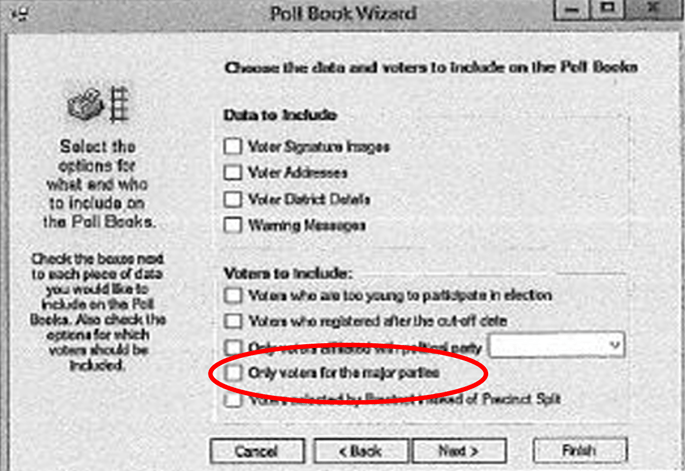
The checkbox for including “Only voters for the major parties” was checked, but it shouldn’t have been, since all voters can vote in a general election. (The checkbox had been used, appropriately, in the primary election earlier in the year. In Pennsylvania, you must register as either a “Republican” or “Democrat” to vote in a primary.)
As recounted in the report, “The task of Poll Book production was left to Employee #2 [supervisor of Employee #3] and Employee #3. Employee #3 was only in a responsible role overseeing voter rolls for a brief period, and only during the 2025 municipal primary. Employee #2 was only in a responsible role overseeing voter rolls for about five weeks prior to the 2025 municipal election, with no prior election or voter services experience.” Neither received training from the State on the use of the system—in fact, no such training is offered.
The report has a series of recommendations for both the County and the Pennsylvania Department of State (which oversees elections), but fundamentally they amount to providing software improvements, better training, and more oversight and verification before the poll books are distributed.
Anyone who has gotten frustrated with confusing and opaque computer programs can understand how this problem occurred. I have sympathy for Employee #3, who should not have been placed in the position of being the only person responsible for the accuracy of the poll books.
The recommendations in the report, to the extent they are implemented (and I’m sure at least some of them have been implemented for this election) will help prevent this problem from ever happening again.

