
This is the first of two posts about Spear Pond, the small pond near the meadow on Kendal’s campus. Although the ruins of a very old house stand next to the pond, the pond itself is a comparatively recent addition. A future post will cover what is being done to preserve and improve the pond, and what could be done to make it even more of an asset in the future.
This first post is about the pond’s history, based mostly on an article that Merritt Cleaver wrote for The Kendal Reporter in May 2016.
George Harlan, an immigrant from Ireland, owned the land beginning in 1700. George gave 200 of his 500 acres to his oldest son Ezekiel, who soon built the house whose ruins now stand by the pond. (In 1710, Ezekiel gave two of those acres for the Meeting House and cemetery, now standing by Route 1.) By 1715, Ezekiel had become the wealthiest of the 43 taxpayers in Kennett at the time.
Sometime after 1727, Daniel Webb and Ezekiel’s daughter Mary built the house that would become the original section of Kendal’s Farmhouse (it was subsequently expanded about 1798 and 1826). The farm then passed through several owners until, in 1949, the Spear family bought nine acres of it. The Spear property included ruins of the old house that Ezekiel Harlan had built.
In 1956, the Spears had a dam built, creating the pond we now call Spear Pond, adjacent to the ruins of the old stone house. The Spears stocked the pond with bass and sun fish. Alex Spear raised Chesapeake Bay retrievers, and he trained them on the pond. At least one became a national champion.
The dam did its job well until about 1978, when a major rainstorm caused it to overflow, and the dam was damaged. It had to be rebuilt.
Not much changed for many years after that. The ruins gradually deteriorated.
In 2016, Kendal resident Merritt Cleaver took an interest in the pond and the ruins, and investigated their history, resulting in the article linked above. You can get a good sense of the state of the ruins then from this photo by Bob Warner, taken around 2015. It is from the Kendal Digital Archive.
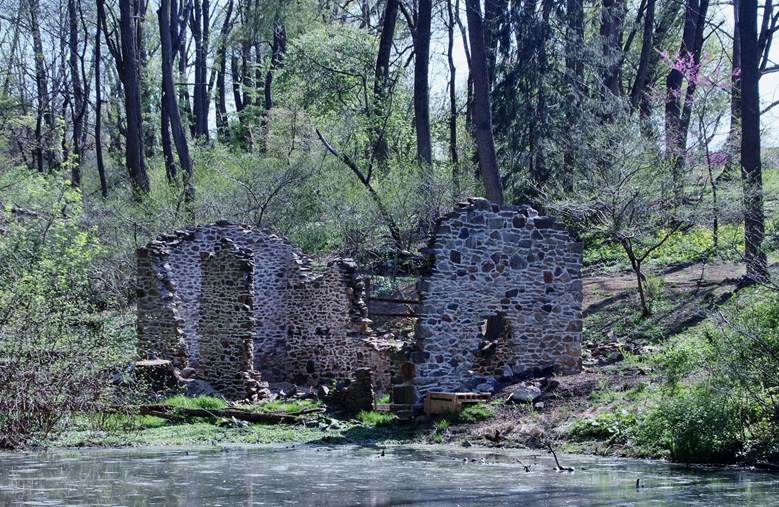
In 2000 Kathleen Gordon and Wallace Ayres got Roy Manno (KCC’s Facilities Director, brand new at the time) interested in the ruins. Kathleen and Wallace launched an effort to clean up the overgrown area. Roy arranged for the ruins to be assessed and carefully reinforced, preventing further deterioration. He also began using a metal detector to dig up numerous artifacts.
The story of this restoration project was the subject of a 2021 Zoom presentation, available on Kendal’s digital archive. In it, Kathleen introduces Roy and provides a bit of background about the pond and ruins. Then Roy describes the restoration project. For those of you wanting more detail about this topic, this video is a good place to start. In addition to a lot of detail about the artifacts that were uncovered, there is historical background and information about possible subsequent work.
In 2024, a small structure, the “Ox Shed”, was built overlooking the pond and ruins. It contains an exhibit of many of the artifacts found around the ruins.
A future blog post will describe the current state of the dam and why it is in serious need of work, what other pond improvements might be done at the same time, and some other ideas about how the pond might become an even greater asset for the Kendal community.
Meanwhile, I encourage readers to check out the pond and the ruins. There are still many residents who are not familiar with this beautiful spot.
 On the Kendal Journey