
This post is a primer on corruption. It is based on a presentation I gave at a Kendal Forward Together meeting on September 18. I’m afraid some of this may seem a little elementary, but bear with me. I hope, once you’ve read this document, that you will agree that the concept of “corruption” is a useful lens through which to see most of the problems emanating from Washington these days.
I’d like to start with the most basic ideas: what is “corruption” and what forms does it take? Today I want to limit myself to just one sphere in which corruption occurs, and that is “political corruption”.
I would define political corruption as political authority used for improper purposes. Those purposes often involve monetary gain by politicians or their allies, but the objective may also be gaining status or power or promoting a specific viewpoint.
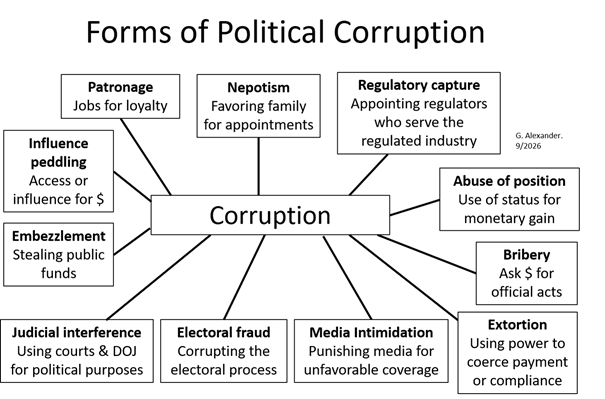
But that definition doesn’t tell us much about what political corruption really is. The picture becomes clearer when we dig into specific categories of corruption. I’m going to divide political corruption into eleven categories.
Categories of corruption. Here are my eleven categories of political corruption. (In the presentation I did, I had only nine. I added two more based on comments following the presentation.)
- Patronage — trading jobs or benefits for political loyalty
- Nepotism (or cronyism) — favoring family or associates in appointments or contracts, regardless of merit
- Regulatory capture — regulators serving the interests of the industries they’re supposed to oversee
- Abuse of position – improperly using status for gain
- Bribery — accepting payment or favors in exchange for official acts
- Extortion — using power to coerce payment or compliance
- Embezzlement — misappropriating public funds
- Electoral fraud — corrupting the process by which power is obtained
- Influence peddling — trading access or influence for money
- Judicial interference – using the Department of Justice and the courts to accomplish political goals
- Press intimidation – punishing media for negative press; purchasing news outlets and changing their policies
It is possible to come up with examples of each of these kinds of corruption in the current administration. In fact, I imagine you have been thinking of examples already.
I won’t try to present an exhaustive list of everything going on in Washington that fits in each of these categories. That would go on for many pages. But I do want to give you some examples of problems arising from corruption, including some where the connection with corruption is not obvious at first glance. A few of these are illustrated in the following diagram.
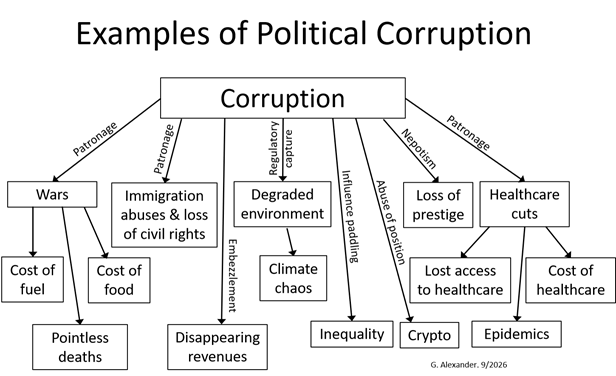
Let’s start with the cost of gasoline, which is high and rapidly getting higher. A big reason for the rise is the closure of the Strait of Hormuz, and that is the result of our war with Iran. And why are we at war with Iran? Well, a big part of the reason is that we have an incompetent Secretary of Defense, and he was appointed because of patronage—which is trading important jobs for political loyalty. That’s corruption. The cost of food is rising and will be going far higher because of a shortage of fertilizer, also because of the Iran war. Many deaths and injuries, both of US soldiers and of Iranian civilians have been caused by this corrupt war.
Similarly, the abuses of the immigration system and of civil rights have been the result of patronage—giving power to appointees with a particular point of view or agenda. Again, corruption.
The degradation of our environment and the cancellation of environmental protections are also to some extent a result of patronage, but they are also the premier example of regulatory capture. The fox has been put in charge of the hen house. That’s corruption.
In just a few years, our country has lost a great deal of the prestige it once had. A big part of that is the incompetence of those representing us in international negotiations. That incompetence, in turn, is a result of family members in positions of responsibility—that is, nepotism.
Our healthcare system is suffering massive cuts. That is causing many people to lose access to healthcare or to have to pay far more their care, either directly or through higher insurance costs. Down the road, we can expect unnecessary epidemics, like the current measles outbreak, because of cuts to vaccination programs. That’s all due to corrupt patronage appointments.
How about the fortunes being made our president and his family by offering crypto? That’s an abuse of position. So is the president’s apparent insider trading. Again, corruption.
And how about the striking growth in financial inequality, with the very rich getting richer and everyone else getting poorer? That’s one result of influence peddling, where the rich “tech bros” can buy influence that keeps their taxes low and their lucrative government contracts rolling in. Corruption.
We don’t know where the billions in revenue from the oil and gold that the US has extracted from Venezuela has gone. It if goes anywhere, It should go to the US Treasury. If it didn’t, that embezzlement. Corruption.
Finally, let me mention five categories of corruption that didn’t make it into the diagram of examples above. Given the available space, I had to leave some out.
One I omitted is outright bribery. Examples are harder to pinpoint, probably because our administration seems inclined to use slightly less blatant forms of corruption. But we do have the example of Tom Homan, the White House border czar, who apparently received a bag containing $50,000 in cash from an undercover FBI agent. The DOJ later dropped charges against Homan, and the whereabouts of the $50,000 has not been revealed.
Another category is electoral fraud. I don’t think outright electoral fraud has taken place at the national level yet, but it’s not for lack of trying. The January 6 insurrection and the attempt to bully Georgia into changing the vote count are prominent examples. Although they are not technically electoral fraud (because they don’t violate our current laws), I consider the recent gerrymandering efforts and the insertion of huge sums of untraceable money into political campaigns a corrupting force on our elections.
Another corrupt activity that didn’t make it into the diagram of examples is extortion. The administration has used its power to force significant changes on law firms (by threatening their government business) and on educational institutions (by threatening their grant money). That’s extortion.
When the administration stacks the courts with partisan judges or forces changes in the procedures of the Justice Department, that’s judicial interference. There are many examples. Some of the most egregious ones are the handling of immigration law and refusal to release the Epstein files.
Finally, there’s press intimidation. From threats to broadcast licenses, to lawsuits against newspapers, to arranging for the purchase of media outlets by allies, the administration has pursued many strategies to intimidate the press into suppressing negative publicity.
So if you pay attention, you can see corruption at work throughout the federal government.
The conclusion I hope you will take away from this blog post is that much of what is wrong with our government today is due to corruption. I know: corruption in government has always been with us, and probably always will be. But this administration has raised corruption to a whole new level. We have been shown the weaknesses of our government, and we cannot leave them unaddressed.
If the political situation changes, we may be able to take steps to alleviate many problems. We may be able to lower prices or improve healthcare or improve civil rights, or address dozens of other specific issues.
But that will not be enough. We will need to weed out corruption from our government and make it impossible to repeat the kinds of abuses we are seeing today. If we do that, we will have taken the first step toward solving many of our problems.
And if we don’t do that, we will have lost our democracy.
—
I should acknowledge that I used an AI package—Claude—to help collect material for this presentation. Going forward, readers can assume that I will use AI for research and organizational ideas in many of my posts. I find AI helpful for those tasks. However, the underlying ideas and the writing are 100% my own, and that will continue.

